Saturday, May 31, 2008

SalmonAid 2008

No, it's not a new protein drink. SalmonAid is a Pacific coast effort to find solutions and support for a fishing industry that's been decimated by poor choices and lack of action. And it's in my backyard for the next two days.

Unless your head's been buried in the sand over the past few months, you already know that salmon season was cancelled this year from California to the Pacific Northwest. Close to 1,000 commercial fishermen have been impacted by the closure and everyone is looking for answers. SalmonAid was formulated in an effort to get groups that formerly lobbed a lot of blame at each other to gather around a cause:
By uniting commercial, tribal, and sportfishing interests with conservation organizations, chefs and restaurant owners, and the American consumer to celebrate and restore our wild salmon and healthy, free-flowing rivers, SalmonAid will inform the public about the historic, cultural, economic, dietary, and environmental benefits of healthy wild salmon populations and the threats to their continued existence.
Typical foggy and chilly Bay Area weather didn't discourage attendees. Manuel and I joined a sizable crowd to visit information booths, talk to fishers and fish conservationists, pose with a giant inflatable salmon, and quaff Sierra Nevada beer. Sounds like a perfect Saturday to me!

Enjoy some pics from our adventures today (my fave is the image of a woman chatting-up a salmon). If you're in the Bay Area this weekend, head to Jack London Square in Oakland and help support an important cause that doesn't just benefit fish, but fishers too.


Well... He Asked

Carnival of the Blue daddy, Mark Powell, over on blogfish trotted-out those ubiquitous LOL Cats--this time in service to ocean conservation. Well done, Mark. I've had an LOL love-affair going for some time with my Hawaii field manager, Liz Foote. Unfortunately, I can't print most of our creations for fear of losing our jobs (or public lynching).

So here's one just for you, Mark. Our new ocean poster child?

Wednesday, May 28, 2008

Marine Protected Areas In Fiji Help Reefs, Help People

While the Fiji Times article failed to mention it, the Coral Reef Alliance has been working directly with Paulo and the Kubulau District in Fiji for over five years to strengthen the Namena Qoliqoli Conservation Corridor. This area includes the world-famous Namena Marine Reserve dive destination.

As Paulo describes, effective MPA management not only means increased fish yields in fishing grounds adjacent to the MPA, but protected areas can generate tourism revenue for community benefit sharing. It's the sort of win-win scenario I love to see.

Voluntary Standards To Support Kona MPAs

Go Kara and Liz! Fresh out of the gate, Kona Field Representative Kara Osada scores CORAL some front page press on our recently launched standards development project on the Big Island. Check out the latest news on this ambitious coral conservation project (a simple user account is required to read stories).

Liz Foote, CORAL Hawaii Field Manager, sums it all up perfectly, "This is an opportunity for people to define the future of their industry, as well as ensure the health and sustainability of our reefs."

Coral Conservation Leaders In Mexico


One of the many things that makes me proud about our approach at the Coral Reef Alliance is that we invest in local people and support their capacity to serve as coral reef conservation leaders.

Case in point, meet the newest additions to the growing CORAL Reef Leadership Network. These Cozumel, Mexico, CORAL Leaders just completed an intensive training in May and are now revving-up to provide trainings to tourism operators on the island in sustainable marine recreation. The fellow at bottom-right in the image is Kenneth Johnson Diaz, CORAL's Mexican Field Representative, who will serve as coordinator for all Leadership Network activity in-country. In addition to working with tourism providers, over the next year CORAL Leaders will also work closely with the Cozumel Marine Park to support MPA management effectiveness.

Felicitaciones, Amigos!

Tuesday, May 27, 2008

Save The Vents, Save The World!

I just finished watching the TV re-make of The Andromeda Strain, one of my favorite 70's SciFi cautionary tales. Suffice to say the original has nothing to worry about. The 1973 film was straightforward: meteor carrying extraterrestrial pathogen strikes satellite, satellite crashes to earth, pathogen wreaks havoc. Gold... sheer box office gold. If it 'aint broke broke, don't fix it, right? But no, the TV re-make had to throw in wormholes, Buckyballs, temporal parodoxes, and government conspiracies.

However, one new twist on the original that I rather liked was the addition of an environmental angle. Turns out the 2008 version of Andromeda has an unusual Achilles Heel. It can only be neutralized by exposure to metabolic chemicals produced by the microbe Bacillus infernus (in photomicrograph at top of post). It just so happens that B. infernus is a thermophile (a type of extremophile) Archaean found associated with active seafloor vent systems at depths of 2,700 meters.

In a timely art imitates life moment, a fictional seafloor mining corporation is preparing to ravage seafloor vent systems for a wealth of poly-metallic ore. So far, so good. But hold on, here's where it gets complicated. Sometime in the future, after seafloor vent systems and their associated Bacillus infernus colonies have been wiped-out, Andromeda pays a visit to this future Earth and presumably wipes out humanity. But not before future researchers can manipulate a wormhole and send an Andromeda sample and a coded warning back in time to a point just before deep sea vent systems are stripped bare. Still with me?

Save the vents, save the world.

So in a preemptive effort to save the world, I'm proposing the following to Nautilus Minerals. In the off-chance that some extraterrestrial pathogen is hurtling to Earth at this very moment, perhaps you should hold-off on strip mining the seafloor off Papua New Guinea. We might need those B. infernus real soon. Heck, why focus on doomsday scenarios. Maybe there's some other organism down there with the potential to cure cancer, or stamp-out HIV, or even grow me a full head of hair? I'm willing to wait and see.

You can thank me later for the foresight.

Monday, May 26, 2008

Two Scoops Of Sardines... Hold The Sprinkles

You've tried fish sticks, fish cakes, fish balls, fried fish, baked fish, grilled fish, and fish roe. Now get ready to add fish ice cream to the menu. News from India's Central Institute of Fisheries Technology (CIFT) indicates a newly developed technology that can prepare nutrition enriched ice cream and noodles using seafood.

Called Maricream (I know, terrible name), the ingredient list reads like a traditional ice cream recipe: water, sugar, butter, egg whites, flavoring substances, stabilizers and emulsifiers. Except the primary ingredient in the prototype product is cuttlefish. Okay, so it's mollusk ice cream. The mixture is whipped and pasteurized to form a rigid foamy substance and is finally frozen at -20 degree Celsius. The ice cream carries no fishy smell. According to CIFT, the resultant product is delicious and protein-packed. The fish noodles are also odor-free yet pack an increased nutritional value.

Regular readers of the blog Shifting Baselines will recall Jennifer Jacquet's recent call to eat like a pig. Her rationale: Stop depleting our oceans of tasty sardines, anchovies, and herring all to produce fishmeal to fatten pigs on factory farms and start filling our own bellies with this often under-appreciated seafood. Being low on the ocean food chain, sardines, anchovies, and herring are more plentiful and don't come with the risks of mercury and other bioaccumulating toxins found in tuna, swordfish, or other big-bodied marine species.

No hard sell for me. I happen to love sardines--my favorite brand being Matiz Gallego Portuguese sardines in olive oil at $2.99 a can. I'm also a big fan of anchovies on pizza, focaccia, in Pasta Puttanesca, or just straight out of the can. And as a good East Coast boy who hasn't met a Jewish deli I don't like, I love a good pickled herring. But I know I'm somewhat of an outlier. As Jennifer has documented, these species are too often unfairly perceived as trash fish here in the States.

Which brings me back to fish ice cream and noodles. While I'm not a fan of a lot of processing when it comes to my food, maybe fish ice cream or fish noodles produced from sardines or herring can help serve as training wheels for fussy American palates and begin a process of weaning consumers from higher ocean trophic levels. It's a big maybe. But if we're going to have any success at salvaging ocean fisheries, it will require some risk taking on kooky ideas. Anyone for a herring hot-fudge sundae?

That's A Moray Monday

This week's moray is yet another example of the confusion of common names. Take a look at the eel in the above image. What common name might you give it? If you're like me, the obvious common name is, well, obvious. But it seems to not be the accepted common name by taxonomists. Ah well, by whatever name, this fish is a beauty.

Starry Moray
Gymnothorax nudivomer


Did you guess "Yellow-Mouth Moray"? I did, and quite a few dive photography sites on the web have used that name for this species. But when I searched for Yellow-Mouth Moray, it directs me to the FishBase taxonomic page for Gymnothorax nudivomer. But the accepted common name for the species is Starry moray. And I suppose I can buy that, given the Milky Way-like field of white starry spots against the darker body color. But come on. Isn't the vibrant yellow mouth more of an eye-catching diagnostic?

The Starry moray is a reef associated eel with a tremendous range. In the Indo-Pacific, it can be found in the Red Sea and Gulf of Aqaba, to South Africa. It can also be found in the Hawaiian and Marquesas Islands, north to Japan's Ryukyu Islands, and south to New Caledonia.

The species has a relatively short, blunt snout. Many morays possess teeth along the surface of the hard palate of the mouth, called vomerine teeth. Some amphibians, like frogs, possess vomerine teeth as well. They're particularly useful to non-chewing predators for holding onto squirming prey items. But larger Starry moray specimens apparently lack vomerine teeth. Another unusual feature is that the larger teeth possess a finely serrated edge.

Starry morays can reach a length of up to 180 cm. (5.9 ft.) and inhabit both inner and outer reef slopes to a depth of 270 meters. According to one source, the slime coating of the species is toxic. Perhaps because of this, no commercial fishery exists for this magnificent fish.

Monster Quest, You're No In Search Of

I knew In Search Of. In Search Of was a friend of mine. But Monster Quest, you're no In Search Of.

Maybe it was the fact that Mr Spock was the In Search Of host and lent a modicum of gravitas to the cryptozoology, UFOs, vampires, Stonehenge energy, and other woo. Maybe it was the groovy, synth-styled musical intro. Maybe it's because I had a little touch of the Fox Mulder as a teen and truly wanted to believe in lake monsters. Whatever the reasons, I was glued to the TV through the 70's whenever I was lucky enough to catch an episode, particularly if they were in search of Bigfoot or Nessie.


But last night while channel surfing, I came across Monster Quest on The Hitler Nostradamus Area 51 History Channel. I rubbed my hands in anticipation of some good-old In Search Of style entertainment. But alas, apparently Bigfoot is so 1975. Nope, today's cryptozooids are a shadow of their former selves. Case in point the farkatke "monster" from last night's episode: Rods.

According to the current cryptozoology canon, rods are mysterious, elongated flying creatures that have been captured on video around the world. The always reliable Fox News even captured a rod soaring over Baghdad. And lest us ocean fans feel left out, fear not. Aquatic rods have been spotted as well. Anywhere from 12 cm to 50 meters in length and sporting multiple sets of wings, these amazing creatures are apparently invisible to the naked eye, yet appear to dart across in plain view when recorded on video. Explanations have ranged from new species of insect, UFOs, "fourth dimension" visitors, and even flying evolutionary relatives from the Cambrian fauna.

But don't just take my word for it. Here's the first several minutes from the Monster Quest episode on rods:


Manuel and I both kept looking back and forth at each other in disbelief. Really? These are the best monsters the producers can come up with? Rods? We felt like someone slipped us crazy pills as we listened to all the explanations of 4th dimensions and living insect fossils. What was perhaps more amazing than the rods themselves were the seemingly earnest and enthusiastic rod "true believers". I don't know whether people suffer from a lack of imagination or labor under an excess of it, but the principle of Occam's Razor was not part of anyone's vocabulary on the Monster Quest documentary.

At least to Manuel and I, two drowsy couch potatoes, these things sure looked like bugs caught in the strobe effect of a video. And guess what? They were. Video, particularly digital video, produces characteristic stroboscopic artifacts when imaging rapidly flying animals, especially insects, but also including birds. The fast passage before the camera of an insect flapping its wings has been shown directly to produce rod-like effects, due to motion blur, especially if the camera is shooting with relatively long exposure times.

And Monster Quest arrived at the same conclusion. Rods are tricks of light, motion blur, artifacts of video photography. No UFOs. No 4th dimension. No flying Cambrian stragglers. But they arrived at this conclusion in the last 3-4 minutes of the episode. As Manuel said, "It took them 30 minutes to reveal this?" Yes it did. And to think, we could have watched a rerun of Project Runway.

What's A Night Of Floating Adrift Over The Great Barrier Reef Worth?

Apparently $250,000 to 1.1 million Australian dollars. That's the current bid range for the story rights to a British couple who went missing this weekend during a dive on Australia's Barrier Reef. Narrowly dodging fame as Darwin Prize contenders, they were found nine miles from where they left their chartered diving boat and air-lifted to safety following an 18-hour search by a dozen aircraft. It's a tale seemingly lifted from Hollywood's recent fascination with similar stories of stranded divers as depicted in the difficult to watch Open Water or its unfortunate, stinkaroo sequel Open Water 2: Adrift.

But it might not just be the water-logged couple who benefit financially from their self-induced ordeal. The Australian reports that the spectacular headlines, particularly in UK newspapers, could reaffirm Australia as the place for adventure tourism, which was a huge draw for the European market. Yes, by all means. What could be a bigger draw for a holiday than the possibility of ending up as bobbing bait to apex reef predators.

But wait, there's more. Australia's online CourierMail reports today that the couple, Richard Neely and Allyson Dalton, are being accused of flouting their dive safety briefing. Some have suggested that the pair ignored rules to immediately surface if they left the dive site in a protected reef known as Paradise Lagoon and got caught in strong current. Six other divers on the boat were all told to go to the surface and wait to be picked up if they exited a narrow underwater channel. Everyone but the missing pair did so.

Immediately selling your story to the highest bidder doesn't convey a tremendous volume of sincerity (or dare I say character). But the fact that the couple was allegedly oblivious to their safety briefing comes as no surprise. It just happens to be the reality that most divers are generally oblivious to both safety and environmental briefings. I've been a diver for 30 years now, so I feel like I speak with some experience.

On a dive boat, most safety and environmental briefings are done hastily and in the final seconds before hitting the water. It's a time when attentions are also focused on adjusting gear, stowing your towel and camera in a dry spot, checking for your buddy, grabbing the final drink of water, spitting in your mask, readjusting your weights, and ignoring the fellow who keeps stepping on your feet and the woman with the annoying laugh. In other words, it's a distracting environment under the best conditions. Studies have shown (Barker and Roberts, 2004) that last minute safety and environmental briefings have about the same effect as saying nothing at all.

What does work? Layered delivery of safety and environmental briefings. When guests first arrive at the dive shop to fill-out paperwork. Another when they board the boat before the engine starts when passengers can sit and listen without distraction. A brief reminder just before the chaos of the first dive begins. And a final refresher during surface intervals between dives. And perhaps most importantly, active, in-water safety and environmental monitoring and interventions must be performed by dive guides. Far from being overkill, this sort of layered delivery pays dividends.

But the usual objections abound. I hear temperamental, seasoned (usually male) divers say it's unnecessary. "You're preaching to the choir," exclaims Rusty MacDivealot, a typical "master" diver, with a roll of his eyes. Meanwhile, his regulator and gauges dangle unsecured ready to snag and break delicate branching corals. He's usually oblivious of the dive group (or his buddy's) location. And guess who's often the first to be seen kicking coral colonies with his fins or picking-up everything he sees? Dive operators also don't tend to step-up their safety and environmental messaging. In a tip-driven industry, the notion that the customer is always right can set a fairly low bar for efforts directed at modifying tourist behavior.

But again, data indicates that most divers are willing to accept a degree of restrictions on their behavior when safety or environmental benefits are explained. Which means that dive operators can't be afraid to deliver regular and consistent messages and set clear limits for how their clients are expected to act. The message can't just be a rushed, one-sentence remark conveyed seconds before the dive. Perhaps the recent Australian incident can provide something of a wake-up call to the dive industry.

Sunday, May 25, 2008

You Don't Really Wanna Damage That Coral, Do Ya?

Coral Reef Alliance staff Elizabeth Curran and Anja Mondragon sporting some 'tude and our new CORAL hats. Conservation never looked so good.

Saturday, May 24, 2008

Roatan Marine Park On Track

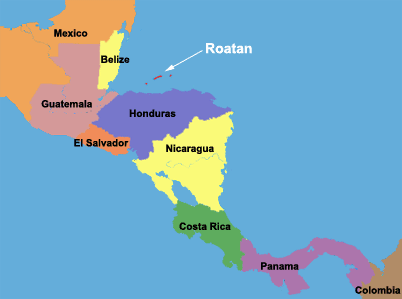
Without active management and local support, marine protected areas are simply "paper parks," protected in name only. But don't say those words on the Honduras Bay Island of Roatan. The marine park there and the pride in reef conservation are stunning examples for what local communities can accomplish.

The Sandy Bay Marine Reserve was officially designated in April of 1989, but effective management took time to build. It took the leadership and vision of dive operators and other West End community members to get things rolling. The Coral Reef Alliance (CORAL) has been working to help strengthen Roatan's Sandy Bay and West End Marine Park for several years now. Through ongoing trainings, educational outreach, and financial support for projects designed to support the MPA's effectiveness, the marine park has achieved impressive results. The park now employs 11 members including a Park Manager (the handsome fellow standing proudly beneath the Coral Reef Alliance banner in the above image is Nic Bach, Roatan Marine Park manager), maintains two patrol boats, collects a voluntary user fee from tourists to offset management costs, and provides outreach and awareness campaigns island-wide.

And the efforts are paying off. There has been a substantial increase in the number of conch and lobster observed on the reef and a noticeable decrease in poaching.

CORAL's Mesoamerican Barrier Reef Program Manager, Rich Wilson, took these pictures from his visit to Roatan last week. He conducted trainings in Sustainable Marine Recreation (the smiling group of West Enders in the below image are marine tourism participants at Rich's training), visited with key partners, and began the planning for a new round of microgrants to fund reef conservation projects. One project we previously co-funded was for the production of marine park educational signage in the Roatan airport (bottom image).


Friday, May 23, 2008

Dark Jamaican Reflections

Jamaican thoughts are milling about in my mind today. You might think images of reggae and paradise abound, but read on. One sad aspect is that I was recently asked by a reporter to comment on Jamaica's once magnificent reefs. While not one of the best headlines I've ever read, the reporter from Hospitality Jamaica allowed me to explain part of the reason behind the current sad state of Jamaica's coral reefs.

I love Jamaica and it's people. My time spent in Jamaica learning coral reef ecology was filled with fond memories of the people and ecology. But there's a dark side to the Island. While I didn't mention it in the interview, a significant downside for me in considering Jamaica as a holiday destination (or one that I'd recommend to others) has to do with it's absolutely deplorable human rights record in the treatment of gay, lesbian, bi, and trans residents.

Homophobia and violence against gay Jamaicans is rampant from cities to villages. Many popular dancehall artists promote violence against homosexuals in their lyrics. Intolerance is preached from the pulpit to the campaign trail of politicians. In 2006, Jamaican Prime Minister Bruce Golding declared in a BBC interview that he would not allow homosexuals to sit in his Cabinet. Gay men are often attacked in public and met with little assistance or compassion. The society neither prevents nor protects against acts of violence against gays and lesbians. The Jamaican Constitution does not protect individuals against discrimination based on sexual identity. In February of 2008, a 24-year-old police officer had to go into hiding in Jamaica after being abused and attacked by fellow officers because of his sexuality. He continues to hear death threats from former police colleagues yet no action is taken.

It says something about the current landscape in Jamaica that J-FLAG, the Jamaica Forum for Lesbians, All-Sexuals, and Gays--the only Jamaica-based group working actively for gay rights and protection--cannot publish its exact location for fear of attack.

Trouble in paradise would be putting things mildly. This isn't the Jamaica in Harry Belafonte songs, the one love in Bob Marley's lyrics, the Jamaican image sold in Club Med ads or depicted in How Stella Got Her Groove Back. But it is, sadly, the current reality. And it's certainly not the Jamaica I remember nor wish to promote.

Maybe He Is A Uniter After All

Well, let's not go that far. But NPR News reports today that President Bush continues to demonstrate his favorite color is blue as he considers an unprecedented marine conservation program that could create the world's largest network of marine protected areas. This would build on his 2006 achievement in proclaiming the Northwestern Hawaiian Islands as the Papahānaumokuākea Marine National Monument.

On the table for consideration are a variety of marine monument proposals that include deep sea reefs in the South Atlantic, coral reefs in the Gulf of Mexico, Rose Atoll in American Samoa, and more than 600,000 square miles of protected area around small, mostly uninhabited islands in the Central Pacific islands and atolls of Palmyra, Howland and Baker. The waters here are biologically rich in coral reefs and are home to huge seabird colonies. If implemented, the remote islands reserve would be among the largest in the world and about three times as large as the Hawaiian monument.

MBSL&S readers will also be familiar with another proposal under consideration: the 100,000 square miles of waters around the Northern Mariana Islands, in the Western Pacific. You'll remember that our distant pal Angelo Villagomez has been spearheading the outreach and support-building for this important addition to the marine reserve program. The proposed monument area includes a portion of the 36,000-foot-deep Marianas Trench, the deepest location on the earth's crust.

I've just gotta guess that WESPAC flunkies and lobbyists are scrambling from office to office on The Hill this week working their special magic to see very little in the way of additional marine protection in the Pacific. The thought of an outgoing President who already has a fondness for ocean protection must give them spontaneous paroxysms.

Despise the perplexing lack of support for the monument from the CNMI legislature, you can bet I'll be rooting for the Mariana Trench National Marine Monument to get a thumbs-up from the Administration. I look forward to sporting my You'll Love How Deep We Go t-shirt in celebration.

Hat tip to David Malakoff for the news.

Thursday, May 22, 2008

Only 1%

During my trip to Turks and Caicos Islands for the Sustainable Tourism Conference, I must have given at least 20 interviews to print media, TV, and radio reporters in attendance. Some of the reporters were kind enough to actually let me know when their stories ran.

Gay Nagle Myers, Senior Caribbean Editor for the trade publication Travel Weekly, put me in the hot seat to provide some rapid fire answers for her readers. Head on over for a little Q&A on Caribbean reefs and tourism's role in conservation.

Wednesday, May 21, 2008

Once More Unto The Breach, Dear Friends

Now that I'm well rested after an extended weekend holiday, it's time to once again draw attention to Nautilus Minerals. A business section cover story in the online edition of Australian newspaper The Age predicts a looming battle between deep sea mining pioneers and environmental groups.

Despite concerns from environmental NGO's such as WWF, Environmental Defense, and Mining Watch Canada as well as calls for a precautionary approach from yours truly and Craig over on Deep Sea News, Nautilus Minerals is ramping-up for the active extraction-phase of it's seabed mining operations in the exclusive economic zone of Papua New Guinea. If all goes according to plan, similar extractive operations will launch in quick order in Fiji and Tonga as well.

The Age article describes how Nautilus awarded a US$66 million contract to Soil Machine Dynamics, a UK-based firm self-described as "one of the world's leading subsea engineering companies specialising in the design and manufacture of remotely operated vehicle systems." I do get a chuckle out of the use of the word engineering. Subsea engineering sounds benign, doesn't it? All very theoretical and with implications that something is being built versus being taken apart.

The deep sea mining machines will resemble giant, abrasive vacuum cleaners. The two sea-floor mining systems will be capable of sucking-up approximately 1.5 million tons of ore annually. Needless to say, poly-metallic ore won't be the only thing scoured from the seabed during extraction. Delicate deep sea benthic communities of coral and the habitat these communities create for fish and other invertebrates will be part of the tailings heap once mining operations begin.

The Soil Machine Dynamics (SMD) website is something to behold. Their products page is a rogues gallery of industrial robots and deep sea mining machinery straight out of a Hollywood sci fi producers imagination. With product names like the Centurion, the Quantum, and deep sea ploughs of every shape, size, and color you can put to bed any question as to whether SMD or Nautilus Minerals operations will be subtle. This is mining, not engineering. The only difference is that deep seafloor mining won't generate a lot of images to raise public awareness and it's a little daunting to stage a protest or form a human chain in front of mining machinery in 2600 meters of water.

Despite assurances from Nautilus Minerals that their process of deep sea mining will have negligible co-lateral environmental impact, they have yet to release details of their environmental impact assessment. Not that their in-house produced assessment will carry much weight for environmental watchdogs. "We would like to see a thorough, independent impact assessment before any mining work begins," remarked Simon Cripps, Director of WWF's global marine program. Catherine Coumans with Mining Watch Canada, echos the call for third-party verification of risk assessment, "I would challenge the company to provide an independent scientific study."

The clock has now officially started on Nautilus Minerals providing evidence that their process poses no co-lateral risks to seafloor ecosystems or coastal coral reefs. Any wagers as to if and when they will respond to their critics?

Florid Holiday Memories

Sorry for the silence of late, but Manuel and I escaped to Mendocino for the lack of e-mail, the foggy evening walks, the organic coffee, the 600 thread count Egyptian cotton sheets at our favorite inn, and for the lush spring coastal gardens in full glory. I took a break from all things ocean and reveled in the amazing floral spectacle. While I get my marine groove back, enjoy a few of my favorite macro's and landscapes.


Friday, May 16, 2008

Coral Reef Science And Management At Your Fingertips


My least favorite portmanteau of the moment is webinar, the pain-inducing love child of website and seminar. But don't let the lousy name stop you from learning cutting edge coral science and ecosystem-based management at this fantastic online learning portal hosted by Australia's ARC Centre of Excellence in Coral Reef Studies.

It's all part of the ARC Centre's International Year of the Reef celebrations and offers a virtual buffet of everything related to coral reef conservation: climate change, MPAs, ecosystem services from healthy reefs... take your pick. All presented by experts in the field and in easily digestible segments.

Love it! Love it! Love it!

Head on over and feed your (coral) head.

Coral Etiquette Signage Gets A Traditional Hawaiian High Five

I just received some very cool pics from an official ceremony yesterday celebrating the installation of our reef etiquette signs at one of the South Kihei beaches on Maui. In attendance (and receiving special recognition for her conservation efforts) was CORAL Hawaii Field Manager Liz Foote (in image below with the ceremony's kupuna.) Way to go, Liz!