Showing posts with label Taxonomy. Show all posts

Monday, August 11, 2008

What Bites Harder Than A T. rex?

No, not The View. Not even Matt Nisbet.

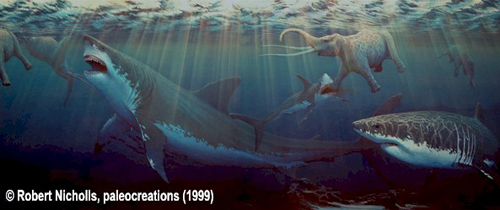
The new crown for most powerful bite force appears to belong to the Megalodon, an extinct species of gargantuan shark that grew to more than 50 feet long and weighed up to 110 tons. Early whales must have breathed a sigh of relief when Megalodon became extinct about 1.5 million years ago. Estimates suggest the toothy terror was at least 30 times as heavy as the largest of its living relatives, the Great White shark.

Technically speaking, megalodon (meaning "big tooth") is the species name for this juggernaut of a shark. But it's the preferred shorthand, given that a bit of a naming squabble is still playing-out over the genus name. When I was but a wee, aspiring marine bio lad, the shark was commonly called Carcharodon megalodon. The genus Carcharodon, meaning "sharp or jagged tooth" also happens to be the genus of the extant Great White shark (Carcharodon carcharias). Due to almost identical shape and arrangement of the teeth of the Great White shark and fossilized teeth of the megalodon, famed Harvard paleontologist and creationist Louis Agassiz proposed Carcharodon as the genus for megalodon as well.

But appearances may be deceiving and convergent evolution can play tricks on the eye, claim a growing consensus of vertebrate paleontologists. Kevin Nyberg (formerly at Duke University) and others say the similarity is merely superficial and that modern Great White's originated from an extinct group of Mako sharks and not from the megatoothed giants. Some paleontologists have proposed the genus, Carcharocles, as a more accurate lineage suggesting that the direct ancestor of the megalodon shark is an ancient shark called Otodus obliquus, which lived during the Paleocene and Eocene epochs. O. obliquus gave rise to Carcharocles aksuaticus, and then a whole slew of Carcharocles intermediaries on the way to Carcharocles megalodon.

Confused yet? Classification wonks can head here if you absolutely must know more about the megalodon naming debate. But back to bite strength.

In a report published last week by the University of New South Wales in Sydney, Australia, researchers suspected that previously published values for maximum bite force of Great White sharks was greatly underestimated. They discovered that previous bite force tests were performed on small bait prey or using materials which likely caused the sharks to "hold back" on full bite delivery. Correcting for this in their new bite tests, researchers also performed elaborate CAT scans (above image) and digital recreations of a great white shark bite musculature (left). They found that the largest great whites have an astounding bite force of up to 2 tons.

"That is more than three times that of the bite of an African lion and more than 20 times that of a human. It's the biggest bite force known for any living animal so far, although it's certainly possible that the killer whale or possibly the larger crocodiles have more powerful bites," reported Stephen Wroe, a biomechanist and paleontologist at the University of New South Wales.

Based on presumed similarities of jaw mechanics, researchers hypothesized that megalodon exerted a bite force six to ten times stronger than the Great White. That surpasses the estimated 3.1 metric ton bite force of Tyrannosaurus rex by a good stretch.

Wroe and his colleagues will detail their findings in a forthcoming issue of the Journal of Zoology.

Monday, July 14, 2008

That's A Moray Monday: The "You Ask-I Deliver" Edition

Never let it be said I won't willingly go to great lengths to keep my readers happy. Case in point, a few weeks ago, Christopher Taylor--Kiwi, "working taxonomist," aficionado of well-groomed facial hair, and author of the blog Catalog of Organisms--commented on one of my That's a Moray Monday posts where I put forward that I don’t like to feature images of preserved (or pickled) specimens (such as the one pictured at the top of this post) from museum collections. To which Christopher responded:
Despite your prejudices, can I put in a request for a post about pickled specimens in jars of formalin? It might be interesting to see a "we don't know as much about morays as we think we do" post. Even as a working taxonomist, it always amazes me to consider just how many organisms - from trees to toads to ticks to tapeworms - we know from specimens floating in jars and absolutely f***-all else.
Ask and you shall receive, Christopher. Mind you, it took a wee bit of time to pose your question and a few others to an arbitrary (though distinguished) cadre of museum colleagues:

• Karsten Hartel, Curatorial Associate and Manager of Ichthyology Collections for the Museum of Comparative Zoology, Harvard University;
• David Smith, eel specialist with the Division of Fishes, Smithsonian Institution; and,
• Dave Catania, Senior Collection Manager, Ichthyology, at the California Academy of Sciences.

My sincere appreciation at the start to all of these busy scientists for taking time from their daily workload to answer my questions. Mr. Catania was happy to provide some feedback, but referred me to the Academy's legendary John McCosker, as he has published extensively on the systematics of Muraenids. Unfortunately, Dr. McCosker was out of town for July and I wanted to get a post in before too long. What I'm most happy to report is that every one of the museum scientists I contacted replied to my rather unusual query within just a few days. In addition to providing great info, they affirmed warm feelings of science camaraderie while also validating that others share my general geekery about all things moray.

Holy Holotype, Batman
I asked Karsten Hartel if the MCZ has one of the more extensive collections of moray holotype specimens (the actual specimen of an organism that's used when the species was formally described.) He explained that in total, the MCZ's moray collection is not that large (material applied to about 35 names). He noted however that the Smithsonian, by comparison, has 102 type specimens. This was confirmed by the Smithsonian's David Smith who said that the august DC institution probably does indeed have the largest collection of morays in the world (in fact, the Smithsonian has the largest collection of preserved fishes in the world). Cal. Academy's Dave Catania reported back that the Academy has 15 Muraenid holotypes. He suspects that the Academy of Natural Sciences in Philadelphia has somewhat more moray holotype specimens.

A Question of Numbers
As far as how many species have been identified, things get a little fuzzy. Karsten noted that if you go to the California Academy of Sciences database (it lists all of the known names ever applied to fishes) and search on Muraenidae (the fish family that includes morays) you will get 533 species names that have been applied to the family at one time or another. However, he explains that we now know that there are almost 200 valid species (Nelson's Fishes of the World says 185) and that is largely because ichthyologists were able to examine the actual specimens used to describe each taxon.

The Smithsonian's eel specialist, David Smith, says no one is really sure precisely how many species of morays there are worldwide. The figure of 200, he said, is almost certainly too low, "We are continually finding new species of morays," reports Smith. "Some species are very widely distributed, while others inhabit only small, restricted areas. One species is known only from Walters Shoals, a submerged reef south of Madagascar. Another is restricted to the Red Sea, and another to the Indian Ocean off South Africa. With the advent of DNA testing, we are sure to find even more species."

Today's Special: Pickled Moray
Getting right to Christopher's primary question of what we know about morays solely from pickled museum specimens, the answer appears to be "quite a lot." The Smithsonian's David Smith responded, "Actually, much of what we know about morays comes from these preserved collections. We can gain information on where each species lives geographically, the ecological habitat, and the variation in characters both within an area and between one place and another." Smith goes on to explain that these preserved specimens also provide information on comparative anatomy, and this in turn can enable us to determine evolutionary relationships.

So with all these one-of-a-kind moray specimens filling up shelf space in museum collections, they must get picked apart and probed a lot, right? "Nope," says MCZ's Karsten Hartel. "Primary type specimens are almost never dissected in order to keep them intact as possible for future generation of scientists," he said. "The non-type parts of the MCZ collections offer a wider opportunity to study all aspects of eel biology from molecular to biodiversity. But by using x-rays or scans, some internal anatomy can be obtained. This, Karsten notes, is very important in eels where the number of vertebrae is incredibly important to understand what is a species and what is not.

Classify Now? Classify Later?
I was curious (as a non working taxonomist) as to the process from collection of specimens in the field to ultimate identification and storage in museum collections. Is this a speedy process or, like a lot of scientific enterprises, does lack of capacity mean that some collected and potentially novel species can sit for quite some time before undergoing classification. In other words, is it possible that our museum collections have new moray species just waiting to be taxonomically defined. David Smith with the Smithsonian was first to weigh-in, "I not only suspect, but I know for a certainty, that many new species of moray eels currently reside in museum collections, some right here at the Smithsonian. With more DNA sampling, those numbers are bound to increase," he said. Harvard's Collection Manager, Hartel, agreed, "I'm sure there are new species out there but I'm not an eel specialist."

I asked if one could quantify an "average time" (if there is indeed such a thing) it might take to ascribe taxonomic description and identity to a collected moray specimen. Do most specimens that are collected by museums sit in bottles on shelves for quite some time before a researcher gets around to writing a monograph or some such taxonomic description? Karsten responded that it's, "Almost impossible to average. He described that the turnaround time depends on current knowledge of the group. "If its a poorly known group that has not been looked at in years, it might require a full review of the group by borrowing material from around the world, visiting museums around the world," he explained. "This can literally take years!"

"On the other hand," he coninued, "if a new very distinctive species is found, then things could move very fast especially with new electronic journals like Zootaxa as was witnessed for the moray species Gymnothorax baranesi. That specimen sat on the shelf since 2002, but once the study was finished and the paper accepted in Nov. 2007 it was published by January 2008."

Smithsonian's David Smith concurred, "There really is no average time between the discovery of a new species and its published description. It depends on the situation." Smith explains, "A scientist may find the new species in the field and describe it shortly after returning to his (her) home base, if he is working on that particular group. Or it may be collected as part of an expedition and sit on a shelf until someone comes along and finds it, recognizes it, and publishes on it. It also depends on how much time a scientist has, how many other tasks compete for his time, etc. It is probably more common for a specimen to sit on a shelf for a while than to be published immediately. There are a lot more specimens in museums than there are scientists to study them. Some groups have no one studying them."

So the message here is clear: We need more moray taxonomists! Hear that, Christopher? For the good of the scientific enterprise, you need to start considering a way to disseminate those taxonomically inclined genes of yours. Take one for the team and get those genes in circulation! Either that or we all need to step up the message that taxonomy and classification is an exciting and living branch of the natural sciences and NOT the dry "stamp collecting" for which it often gets the unfair rap.

The Science Behind The Specimens
A final query I put to my museum contacts was to describe some of the current or recent scientific research in which museum moray specimens have proven vital. Karsten Hartel was first to respond that, "During my tenure, MCZ material (and other museums) has been very important for scientists who have studied eels. One example is the two volume (adults and leptocephali) work on the eels of the western North Atlantic or the Fishes of the Atlantic Ocean regional series." He also provided a link to the volume that describes species from the Western Central Pacific.

Both Karsten and Cal Academy's Dave Catania both pointed out that museum specimens are proving crucial in compiling online, searchable databases for fish species. Karsten mentioned that, "information on the holdings of major museums are being assemble into searchable databases (see the Global Biodiversity Information Facility) which is becoming more and more important for understanding diversity, especially in difficult to identify species where access to museum specimens is a necessity." Catania mentioned that FishBase is another searchable site that is assisting scientists in better understanding fish diversity and biogeography.

Dave Smith with the Smithsonian reminds us that while we have compiled new understandings of morays, a lot of scientific work remains to be done. To this point, he adds, "Very little is known about the anatomy and the biology of morays. Only a couple of species have ever had their osteology (structure of the bones and skeleton) described, and we know very little about their ecology, behavior, and reproduction, except in the most general sense. So, there is much more to learn about morays."

So there you have it, Christopher. Seems we have mapped just the tip of the iceberg in so far as understanding moray species. It's exciting to think that there’s still plenty of work and understanding yet to accomplish. Which to me at least is incredibly encouraging to think that future generations of marine biologists, taxonomists, and museum curatorial personnel can take-up the challenge.

Monday, June 30, 2008

That's A Moray Monday

You might think that with over 200 described species of moray eels, selecting a candidate eel to feature each week would be a snap. But just because there are over 200 described species doesn't mean finding suitable pictures for my posts is easy. A lot of the taxonomic images for the less-common moray species are photos of pickled specimens that sat in jars of formalin for days, weeks, or years before someone got around to describing the species. Needless to say, not the most compelling imagery. Regular readers will note that I like to feature living specimens in natural settings. Call me picky, but I like living things.

Anyway, it took some searching but I found a great eel to feature this week with plenty of on-reef shots.

Mosaic Moray
Enchelycore ramosa


I think someone goofed on the common name of this moray species. While perhaps Mosaic moray could be used to describe the mosaic-like pattern of splotches and geometric shapes along the eels body, I think a better name might be Scary Mouth-Full-of-Teeth moray. Typical of the Enchelycore genus, the Mosaic moray sports a gaping mouth with needle-sharp teeth along the margins of the arched jaws as well as teeth studding the roof of the mouth. All the better to grasp and hold onto small reef fish, crustaceans, and juvenile reef octopus.

The Mosaic eel is yellow to grey in color with a mosaic pattern of darker lines. It reaches a maximum length of about 150 cm. (4.9 ft.). It inhabits coral and rocky reefs in the subtropical and temperate Pacific from southeast Australia and New Zealand eastward to Easter Island.

Monday, June 23, 2008

That's A Moray Monday: The "I Haven't Posted One Of These In Weeks" Edition

Apologies to those taxonomically inclined readers who may only frequent MBSL&S for the Moray Monday feature. But I promise I'll go "big" on my return to cataloging the wonderful world of morays with this week's edition. To wit: How can you get any bigger than the Giant moray?

Giant Moray
Gymnothorax javanicus


At the risk of being called a size queen by Christopher over at Catalog of Organisms, I must admit that this fish is impressive! At a recorded length of 300 cm. (9.8 feet) and weighing-in at 30 kg. (66 pounds), G. javanicus is a true giant. This is the largest Indo-Pacific moray eel, found in the Red Sea and East Africa to the Marquesas and Oeno Atoll (Pitcairn Group), north to the Ryukyu and Hawaiian islands, south to New Caledonia and the Austral Islands.

Because of its position at the top of the reef's food chain it is often ciguatoxic. This is a beautiful example of biomagnification as ciguatoxin bioaccumulates in lower trophic level organisms, resulting in higher concentration of the toxin at higher levels of the food chain. Predator species near the top of marine food chains in tropical waters, such as barracuda, moray eel, parrotfish, grouper, triggerfish, and amberjack, are most likely to cause ciguatera poisoning, although many other species have been found to cause occasional outbreaks of ciguatera. Ciguatoxin is very heat-resistant, so ciguatoxin-laden fish cannot be detoxified by cooking.

While the Giant moray exhibits similar reclusive behavior--in keeping with smaller moray relatives--the sheer size of the Giant moray and tendency to not back-down have earned it a reputation among divers as more prone to attacking when provoked.

When not attacking stupid divers, the Giant moray can be found in lagoon habitats and on seaward reefs. They feed primarily on fishes and occasionally on crustaceans. It's a commonly seen species along deep drop-offs and slopes in Indonesian waters. The Giant moray exhibits slightly different coloration from juvenile to adult. Juveniles are tan with numerous large black spots while adults have black specks that grade into leopard-like spots behind the head and a black area surrounding the gill opening.
Monday, May 26, 2008

That's A Moray Monday

This week's moray is yet another example of the confusion of common names. Take a look at the eel in the above image. What common name might you give it? If you're like me, the obvious common name is, well, obvious. But it seems to not be the accepted common name by taxonomists. Ah well, by whatever name, this fish is a beauty.

Starry Moray
Gymnothorax nudivomer


Did you guess "Yellow-Mouth Moray"? I did, and quite a few dive photography sites on the web have used that name for this species. But when I searched for Yellow-Mouth Moray, it directs me to the FishBase taxonomic page for Gymnothorax nudivomer. But the accepted common name for the species is Starry moray. And I suppose I can buy that, given the Milky Way-like field of white starry spots against the darker body color. But come on. Isn't the vibrant yellow mouth more of an eye-catching diagnostic?

The Starry moray is a reef associated eel with a tremendous range. In the Indo-Pacific, it can be found in the Red Sea and Gulf of Aqaba, to South Africa. It can also be found in the Hawaiian and Marquesas Islands, north to Japan's Ryukyu Islands, and south to New Caledonia.

The species has a relatively short, blunt snout. Many morays possess teeth along the surface of the hard palate of the mouth, called vomerine teeth. Some amphibians, like frogs, possess vomerine teeth as well. They're particularly useful to non-chewing predators for holding onto squirming prey items. But larger Starry moray specimens apparently lack vomerine teeth. Another unusual feature is that the larger teeth possess a finely serrated edge.

Starry morays can reach a length of up to 180 cm. (5.9 ft.) and inhabit both inner and outer reef slopes to a depth of 270 meters. According to one source, the slime coating of the species is toxic. Perhaps because of this, no commercial fishery exists for this magnificent fish.

Monday, May 12, 2008

That's A Moray Monday: The Miriam Goldstein Edition

As some of you ocean science blog types may know, one of my colleagues--Miriam Goldstein (one-half of the oomph behind the utterly fantastic blog The Oyster's Garter)--has been in Curaçao for the past few weeks tormenting reef invertebrates, killing helpless fish, and likely grinding defenseless coral polyps under foot conducting research.

Shortly after arriving in Curaçao, Miriam reported being afflicted by a mystery sting on her hand. So painful was it that it caused her to entirely miss on a guest post at Coral Week at DSN, thus trumping my own lame-ass excuse for not guest posting on Coral Week due to an international speaking engagement and an inordinate fondness for drinking rum when not working.

This being Miriam's first foray into tropical reefs, she learned the hard way that tropical marine ecosystems are home to an evolutionary arms race of self-defense systems. She summed things up nicely with,
The moral of this story? Looky, no touchy is BY FAR the best way to hang out on a reef. Collecting tunicate samples is way more harrowing than I thought it would be. On top of the fireworm, I almost got nailed by an extraordinarily attractive and extraordinarily toothy Golden Moray yesterday. (Rick would be…so proud. Scroll down for his That’s a Moray Monday series with all the moray goodness you can handle. Except for the golden moray. Rick, do you take requests?)
Why yes I do, Miriam. Thanks for asking! But coming-up with an answer wasn't straight-forward.

The nightmare of common names left me with a few possible directions to pursue. Google-ing her initial ID, "Golden Moray," came-up with only 10 hits. The closest match was Gymnothorax melatremus which goes by the common name "Golden Moray" but also "Dwarf Moray" on Fish Base. But I ruled this species out as soon as I noticed its range seemed limited to the Indo-Pacific (Indonesia specifically). Well that's not close to Curaçao.

Turning to my bookshelf, I next did what any marine ecologist trained in systematics, cladistics, and the use of dichotomous keys would do: With a beer in hand I leafed through pretty pictures until I found a yellowish-golden moray eel. Reef Fish Identification: Florida, Caribbean, Bahamas by Paul Humann lists two candidate eels that might be Miriam's sighting. The first golden-colored eel was Gymnothorax saxicola, the "Honeycomb Moray," (see image at left). Typical coloration is shades of cream to yellow, yellow-brown, or brown. Check! Constantly opens and closes a mouth filled with needle-sharp teeth. Check! But wait, the Honeycomb moray's range rarely extends south of Bermuda. Also, it's preferred habitat is turtle grass beds, not coral reefs.

Which leaves me with the only other Caribbean, golden-colored, reef-dwelling suspect eel and the star of this week's Moray Monday.

Goldentail Moray
Gymnothorax miliaris


Goldentail?! Goldstein?! Wait a minute... I smell a set-up! Be that as it may, this is a doozy of a moray and I'm delighted Miriam's close encounter brought it to my attention.

From what I can tell from the color variation in photographed specimens on Fish Base, the Goldentail moray either has several color morphs or it is decidedly more yellowish in color as a juvenile. For comparison, here's one image of Gymnothorax miliaris from its taxonomic description:

Here's another from the same page:

They almost look like different species. Either of these resemble your stalker, Miriam?

The Goldentail moray reaches a maximum length of about 70 cm (2.3 ft). It ranges from the Western Atlantic (Bermuda and southern Florida) to the Antilles (can you say Curaçao?) and southeast Brazil. In the Eastern Atlantic it has been documented in St. Paul's Rocks, Cape Verde, Ascension and St. Helena islands as well as the Azores.

A benthic and solitary species, the Goldentail moray inhabits reefs and rocky shorelines usually to depths of 60 meters but prefers shallow to mid-range coral reefs. It is active during the day and sometimes seen hunting together with other reef predators. As troublesome as it was to initially ID, Paul Humann considers it to be one of the most common and easily recognized morays of West Indian reefs.

Despite a menacing appearance, the Goldentail moray is considered non-aggressive (like most morays). It's gaping-mouth appearance has more to do with respiration than threat posturing. Though I must again flaunt my morbid side by saying that since she denied us all a peek at her swollen, mystery-stung hand, the very least Miriam could do is bring back pictures of a moray bite to satisfy us ghouls. It doesn't have to be her own hand. That's what dive buddies are for!

Well, Miriam, I hope you enjoyed this tribute post. Just know that henceforth, Gymnothorax miliaris will always be fondly known to me as the "Goldenstein-tail moray." What it lacks in euphony it exceeds in mirth.