Monday, June 29, 2009

Live Blogging: National Marine Educators Association Conference

I'm in beautiful Pacific Grove, California, for the next few days as I attend the National Marine Educators Association Conference. Ah, Pacific Grove, or just PG to the locals. Hallowed stomping grounds of my hero, the legendary American marine biologist Ed Ricketts.

When I moved to California in 1997, I didn't bring much with me. A futon bed, some clothes suitable for San Francisco's microclimates, a box of my old field journals, and a single book: my copy of Ed Ricketts Between Pacific Tides, his pioneering study of Pacific intertidal ecology. Not a field guide, per se. And certainly not the most accessible of books. Nonetheless, Ricketts book meticulously describes the intertidal zonation patterns of the Pacific Coast as well as the ecology and aspects of the natural history of the organisms that live there.

As an east coast marine biologist trained and familiar with life between Atlantic tides, I had a lot to learn on Pacific shores and I knew I wanted to learn from the master.

I've made many sojourns down to the Monterey Peninsula since moving to San Francisco. I've walked along Cannery Row, though have found it impossible to glean any sense of place from Ricketts heyday. Bubba Gumps and Starbucks have effectively destroyed any vestige of the working class fishing town immortalized by Steinbeck. I've stood in front of the life-sized bust of Ed Rickets near the corner of Wave and Drake Streets, site of the long-defunct rail crossing where in 1948 the Del Monte Express hit Ricketts car. Ed Ricketts died three days later. But even here, I still didn't feel like I touched the man.

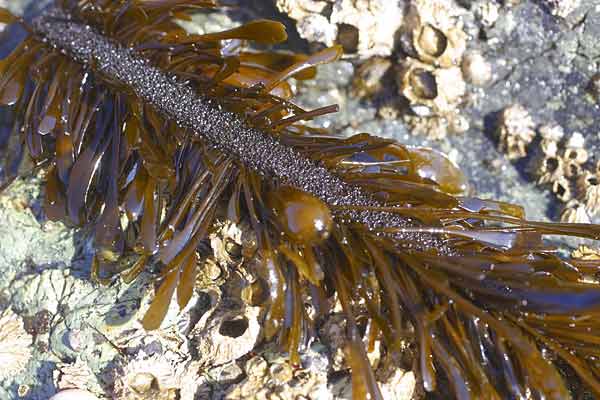
It wasn't until I was knee-deep in the Great Tide Pool near Point Pinos, in Pacific Grove that I really felt like I could understand Ed Ricketts. Ricketts was known to collect specimens in the Great Tide Pool area and John Steinbeck mentions the Great Tide Pool in his book Cannery Row. There, legs numb in the cold Pacific water and entangled in rubbery Egregia menziesii, I understood I'd at last found the man in one of his most cherished haunts.

In The Log from the Sea of Cortez, John Steinbeck traveled with, observed, debated, and drank with Ed Ricketts over the course of six weeks. While much of the "action" tends to focus on the Mexican leg of their journey, I've always loved their first few days along the rocky California coast of Monterey. In these early pages, Steineck expounded on “the brilliant colors, the swarming species” of tide pools. A simple study of a “small and perfect pool,” he concluded, offers an understanding that “all things are one thing and that one thing is all things.”

I still haven't made my own sense of that most favorite of Steinbeck's and Rickett's riddles. But it's nice to be in PG yet again, and get a few more chances to get my legs wet and puzzle it over.

Keep checking back through the week for conference updates.

Friday, June 26, 2009

Just In Time For SF Pride Weekend: Homosexuwhales

Call Off The Corpse Dogs! Daniel's Alive!

That's right, Irradiatus of the always stellar Biochemical Soul blog is back in the world of the virtual after a many month soul (and job) searching hiatus. I was beginning to wonder if the Darwin Beard Challenge boys had extremely eliminated him from the running.

Phew!

And in an attempt to curry favor with the cool ocean science blogosphere hordes, he goes and lands a sweet new gig researching echinoderm development at Carnegie Mellon. Witness his blatant effort at bribing his way into the hearts of the few, the proud, the marine biologists with his artistic rendering of an echinoderm cladogram (above).

Sorry Daniel, it's not that easy! Sure, your beautiful echinoderm genealogy now graces my desktop wallpaper. Sure, I'm tickled at the prospect of regular echinoderm evolution posts. But it's gonna take a whole lot of alcohol peddling and shanty-singing at ScienceOnline'10 to earn your pirate's cap.

PS: Welcome back!

Wednesday, June 24, 2009

Don't Let The Bed Bugs Bite

Well, this email got my day started with a belly laugh. I'm thinking the Orkin exterminator folks didn't actually read my blog very closely. File this under, Say What?
Dear Rick

My name is Tiffany and I am contacting you regarding your site
located at http://coralnotesfromthefield.blogspot.com

I'm working with Orkin.com, a leading pest control provider. We feel that the information on your site very [sic] useful and informative. We think that adding a link to our Bed Bugs section would be a nice addition for your users. Would you please consider adding a text link?

To add it your site, you could simply copy and paste the code below:

Bed Bugs

Please let me know if you have any questions.

Kind regards,
Tiffany Hamilton

Tuesday, June 23, 2009

A Tale Of Two Corals

As you may have seen over on Deep Sea News, the Living Oceans Society's Finding Coral Expedition has successfully found coral in British Columbia.

How are deep water coral different from more familiar tropical, shallow water coral species? Check out the expedition video above for some answers.

Monday, June 22, 2009

That's A Moray Monday: The Reading Is FUN-damental Edition

My inverte-phile buddy Eric Heupel over at The Other 95% sent me a heads-up on a perfect Moray Monday event over in his back yard in The Constitution State. Dr Tim Watson, a volunteer diver and underwater photographer at Mystic Aquarium & Institute for Exploration, has written a children's book that has my name written all over it.

His illustrated book, Howard's Search for a Home: An Underwater Adventure of a Moray Eel, is the sort of book I wish I had when I was a kid. I have yet to see the book myself, but according to the description, Watson's book "uses vibrant underwater pictures for the younger child's visual aesthetics, a simple humorous story line for young readers, and incorporates an educational aspect of each species encountered to promote ocean animal appreciation and learning. The book may also be a good avenue for children to open a dialog with adults around understanding retirement."

Understanding retirement? I do need to read this!

And perhaps best of all, a portion of the proceeds of book sales will be donated to the Mystic Aquarium's volunteer SCUBA program, research, and marine mammal stranding programs. Ah, the Mystic Aquarium! As an undergrad, my family would stop at Mystic Seaport when we drove through Connecticut on our way to Rhode Island. If memory serves, I'd complain nonstop until we all marched to the aquarium admissions. Good times!

If you're in the Mystic or New London area, Tim Watson will talk about moray eels and sign copies of his book on Saturday, June 27 at Michael's Dairy in New London. I suggest you try a scoop of Monster Mash--vanilla ice cream, caramel swirl, malted milk balls, Oreo cookies, and M&M's. Join Watson between noon and 2:00 p.m. to learn about the remarkable underwater life in the world of a moray eel.

Ice cream and moray eels. Does it get any better?

And as a final bonus, check out this interview that ScubaSave.com landed with author Tim Watson.

Friday, June 19, 2009

Hey EPA... Get Your Acidification In Gear!

I'm proud to say that the Coral Reef Alliance (CORAL) joined thirty-one other conservation organizations (see below) in urging the Environmental Protection Agency (EPA) to adopt stringent water quality criteria that adequately protect marine life from ocean acidification. The EPA invited people to submit information on ocean acidification for their consideration during its review of water quality criteria under the Clean Water Act.
On behalf of the American Fisheries Society, Blue Ocean Institute, California Coastkeeper Alliance, Campaign to Safeguard America’s Waters, Center for Biological Diversity, Clean Water Network, CORALations, Coral Reef Alliance, Environmental Defense Center, EPIC (Environmental Protection Information Center), Friends of the Earth, Greenpeace USA, Gulf Restoration Network, Humboldt Baykeeper, International Center for Technology Assessment, KAHEA: The Hawaiian-Environmental Alliance, Marine Conservation Biology Institute, Niijii Films (producers of A Sea Change: Imagine a World without Fish), Northcoast Environmental Center, Oceana, Pacific Environment, Palm Beach County Reef Rescue, People for Puget Sound, Reef Relief, Sailors for the Sea, San Francisco Baykeeper, Santa Barbara Channelkeeper, Southeast Alaska Conservation Council, Turtle Island Restoration Network, Western Nebraska Resources Council, Wildcoast, and Xerces Society, we thank you for the opportunity to submit information on ocean acidification for the Environmental Protection Agency (EPA) to consider during its review of water quality criteria under the Clean Water Act. We support EPA’s call for data and information and urge EPA to adopt stringent water quality criteria that adequately protect marine life from ocean acidification.

Ocean acidification is a serious threat to our ocean ecosystems. Carbon dioxide pollution, primarily from fossil fuel use, is changing seawater chemistry more rapidly than anything that oceans have experienced in millions of years. These corrosive waters impair the ability of plankton, corals, and shellfish to build their protective shells. It also compromises other biological functions of wildlife including fish. The consequences of ocean acidification will impact ocean ecosystems, coastal resources, and our economy.

The threat of ocean acidification should be at the top of priorities for ocean conservation. Carbon dioxide is fundamentally changing ocean chemistry with devastating impacts on wildlife. Unless carbon dioxide emissions are stabilized, scientists predict that rising ocean acidity could cause a collapse of the world’s fisheries. The science that has developed concerning ocean acidification over the past decade indicates that this is a water quality problem needing serious attention and urgent action.

The Clean Water Act’s goal is to “restore and maintain the chemical, physical, and biological integrity of the Nation’s waters.” Thus, the EPA and states have had decades of experience protecting our nation’s waters from pollution under this law. EPA has the authority and the duty under the Clean Water Act to protect seawater quality from ocean acidification. EPA should strengthen its water quality criteria to ensure the maintenance and protection of ocean life and habitat. EPA is also encouraged to publish guidance on ocean acidification to enable coastal states and water quality managers to monitor and develop approaches to ocean acidification.

We applaud EPA for taking action on this important issue and hope to see further steps to address the problem of ocean acidification.

Thursday, June 18, 2009

World Database on Marine Protected Areas

Less than 1% of the world's ocean (0.7% to be exact) is protected within marine protected areas (MPAs). That's an alarming statistic, especially considering that all the data points to well-managed MPAs and MPA networks as our best defense in conserving species and ecosystems.

In an effort to get more people to understand what MPAs are, where they are located, and how they work, the World Database on Protected Areas (WDPA) was launched as a new tool for ocean conservationists. But beyond merely an education and awareness tool, the WDPA is the most comprehensive global spatial data set on marine (and terrestrial) protected areas available. Using a Google Earth and Google Ocean interface, visitors can tap into videos, images, and Wikipedia entries for each and every MPA on the planet, from the largest (Phoenix Islands Protected Areas, Kiribati) to the smallest (Echo Bay Provincial Park, Canada).

For example, I selected the Bacalar Chico Marine Reserve on Ambergris Caye in Belize, and was taken to a detailed Google Earth satellite map (click below images to enlarge) of Bacalar Chico with data layers for coral reefs, mangroves, seagrass beds, and salt marshes.

Another click pulls down detailed info on Bacalar Chico such as GPS coordinates, total area, protection designation, and more.

But the WDPA website is not just a public education portal. Conservation professionals can explore marine protected areas through interactive maps at a national or international level, search the global database for protected areas by country or protection designation, download geographic information system (GIS) data on protected areas, or upload new GIS data sets to the database.

How important is having better marine protected area management tools like the WDPA online site? Consider this view, “Marine protected areas are critical to the future of the oceans and they will ensure that the ecosystem services on which millions of people around the world rely for their livelihoods and existence will be maintained,” explains Kristian Teleki, Head of the One Ocean Programme and Director of the International Coral Reef Action Network (ICRAN) at UNEP-WCMC. “Without Marine Protected Areas and the efforts of governments, conservation organizations and communities around the world to manage and conserve the marine environment, the future of the oceans and the diversity of life contained within them will be jeopardized.”

Check it out yourself!

Wednesday, June 17, 2009

Don't Make Him Bust Out His Sharks With Frickin' Laser Beams Attached To Their Heads

Dr Evil David Shiffman, one-half of Southern Fried Science blog and he of boundless shark conservation enthusiasm, has been working with other shark aficionados to protest The Discovery Channel's portrayal of sharks in their now famous “Shark Week” series.

According to David and other shark bloggers, rather than dispel stereotypes, The Discovery Channel continues to falsely portray sharks as violent and dangerous, showcasing shark behavior in what is now being called “shark porn”.

Since David has schools of sharks with frickin' laser beams attached to their heads is such a charming guy, he threatened convinced The Discovery Channel Senior Science Editor and Executive Producer Paul Gasek to answer reader questions and respond to their concerns on Southern Fried Science.

So head over to Southern Fried Science and submit one-billion dollars your question to The Discovery Channel in the “comments” section. The Discovery Channel can only respond to 10 questions, so make yours a good one.

Now call off the frickin' sharks, David! I've done your bidding.

Sponge Worthy?

Well, are you?

If you think you are, then mosey-on over to The Sponge Guide, a brand new web-based, fully searchable pictorial guide to Caribbean sponges.

This guide is the brain-child of taxonomist Sven Zea, Universidad Nacional de Colombia, by database and web-designer Tim Henkel, formerly a PhD student at the University of North Carolina, Wilmington, and now a postdoc at Murray State University, KY, and coordinated by Professor Joseph Pawlik with support from the US National Science Foundation, Biological Oceanography Program.

With more than 170 sponge species primarily from the Bahamas currently cataloged on the site, the project coordinators hope to add additional species from the wider Caribbean in coming years.

Check it out and let them know what you think.

Tuesday, June 16, 2009

The Violets In The Mountains Have Broken The Rocks

It's Pride month (SF Pride is next week) so I thought I'd get y'all in the Pride spirit with a beautiful speech by Patricia Clarkson.

Johnny Depp Feeds Hot Dogs To Sharks To Relax

This is a post to keep Liz Foote happy. Never let it be said that I won't pander for cheap photoshopping laughs. But honestly, when Liz sent me this little slice of celeb-reality, I knew I had to post it.

Here's the full story, courtesy of Expose.com:
Johnny Depp feeds hot dogs to sharks to escape his crazy life. The "Pirates of the Caribbean" actor has his own private island in the Bahamas and whenever the pressures of fame get too much for him he goes there to play with the killer fish and forget about acting.

Depp - who has two children, Lily-Rose, 10, and seven-year-old Jack, with French partner Vanessa Paradis - said: "Whenever I was getting frustrated about being 'novelty boy' and making movies, I told myself, 'Calm down.' I can come down here and disappear. I spent the Christmas season here with Vanessa and the kids. You can feed hot dogs to the nurse sharks in the Exumas (the Bahamas Out Islands) - but it's best to not swim when doing it!"

Depp, 45, doesn't think he would be able to cope with his hectic life if he didn't have the 45-acre island, known as Little Hall's Pond Cay.

The screen heartthrob - who mainly lives in Paris with his family - added in an interview with Vanity Fair magazine: "I don't think I'd ever seen any place so pure and beautiful."

"It's my decompression. It's my way of trying to return to normalcy. Escapism is survival to me."

"You can feel your pulse rate drop about 20 beats. It's instant freedom. And that rare beast, simplicity, can be had. And a little morsel of anonymity."

Actually, that sounds pretty relaxing. If anyone is looking for me, I'll be down at Pier 39 feeding hot dogs to the killer fish in San Francisco Bay (a.k.a. sculpin).

Monday, June 15, 2009

Finding Coral: The Movies

James Gates with Living Oceans Society was kind enough to send me links to the YouTube videos from their Finding Coral Expedition that's exploring the depths off the coast of British Columbia looking for deep water corals and recording the damage from bottom trawling.

Peter over on Deep Sea News has been posting about the expedition as well.

Check out the videos and learn about some of the amazing people involved in this expedition, the fascinating life along the sea bottom, and the tragic damage inflicted on deep sea habitats from unsustainable fishing.


That's A Moray Monday: The Eelegal Alien Edition

Thanks to my pal Karen James (she of the august Natural History Museum in London and The Beagle Project), I was alerted to news that a moray eel was captured last week by fishers off the coast of Cornwall, England.

John Payne, a fishmonger in Penzance, spotted the eel at a fish market and paid £3o ($48) for the specimen, which he apparently plans to have mounted as a most unusual trophy.
"I thought it shouldn't be there," remarked Payne in an interview with the Daily Mail, "I realized it was rare and it shouldn't be swimming in these waters so I decided to buy it. It is a one off and first of its kind found in these waters."
Well, maybe.

Perhaps it's the first documented incursion of a species typically found in tropical and sub-tropical waters, but as we are seeing in many locations around the globe, warming seas and unusual temperature fluctuations in ocean currents has allowed historic species ranges to blur or expand, creating so-called No-Analog ecosystems.

In both The Sun coverage of the news (above) and The Mail, reporters just couldn't resist a bit of hyperbole and sensationalism in describing the moray. (Egad! Sensationalism from British tabloids?!) The Mail reported that "it's the first time the vicious eel species has ever been found in British waters." And both news outlets mentioned that moray eels are "usually found in the warm coral reefs off the Indo-Pacific oceans."

Don't these reporters read Malaria, Bedbugs, Sea Lice, & Sunsets?

Morays are a reclusive species and only appear to show a vicious streak when pestered by divers. And while the majority of moray species do indeed favor sub-tropical and tropical marine ecosystems, they are not just found in the Indo-Pacific but occur world-wide. In fact, several species make a perfectly happy living in temperate waters as well. Just south of San Francisco in the kelp forests of Monterey Bay, the California Moray (Gymnothorax mordax) can be found in cold water rocky reef areas.

Thanks for the heads-up, Karen!

Sunday, June 14, 2009

A Blog Worth Bookmarking

This is some much-belated recognition of a relatively new yet terrific blog with a particular affection for things oceanic. Labrish: Musings on Earth and Life From a Jamaican Abroad first caught my attention when Kathy Stanley, the blog's author, wrote me with a fascinating rumination on the Paradox of Whale Watching.

I didn't just learn coral reef ecology during my field work in Jamaica. If memory serves, "Labrish" is Jamaican Creole for "gossip" or "chitchat". What we call "the Coconut Wireless" in the Pacific. All I can say is Labrish is speaking my language!

I highly recommend adding Labrish to your blogroll and keep an eye open for more ocean-themed posts.

A belated welcome to the blogosphere, Kathy, and hope to see you in Carnival of the Blue too!

Saturday, June 13, 2009

Feeding Stingrays Makes For Lazy, Fat Stingrays

Is anyone surprised by these findings? Dr. Bradley Wetherbee, a University of Rhode Island professor, has studied tourist activities in Stingray City Sandbar in Grand Cayman since 2002 and has concluded that human feeding and habituation is responsible for the disruption of natural stingray behaviors and an increase in the size of the female population in stingrays.

In other words, lazy, fat stingrays.
"From an evolutionary point of view, for millions of years these stingrays have been nocturnal," Wetherbee said. "Tourists start feeding them during the day and they reverse their behavior. They became very active during the day, or diurnal, which they never were before, and now they sleep all night."

Wetherbee explained that in the wild, stingrays are bottom-feeders, and do not typically eat non-natural prey items, such as squid, which many tourists have been feeding them.
Wetherbee's most recent findings further corroborate previous research demonstrating that supplemental feeding changes the activity patterns, feeding habits and reproduction of stingrays. In 2006, then graduate student Mark Corcoran at Nova Southeastern University in Florida tagged and tracked more than 150 stingrays, comparing those that frequented Grand Cayman's Stingray City with unfed wild rays from other habitats.
They found that the fed rays remained at the Sandbar during the day, ranged around a bit at night and then returned to the Sandbar the next morning. The wild rays headed out to deeper water during the day and returned to South Sound at night, moving around farther and more frequently than their human-habituated counterparts.

"The supplemental feeding reversed the activity pattern," Corcoran said. "It changed from resting during the day and foraging at night to reversal of that pattern." The researchers concluded that tidal phase had no effect on the animals' activity space.

The scientists also noted that the fed animals were much fatter than their wild cousins and tended to reproduce all year long on the Sandbar instead of in cycles.
Stingray City has become an incredibly popular marine recreation attraction on Grand Cayman in the Eastern Caribbean-situated Cayman Islands. Two main areas comprise the stingray attraction on Grand Cayman: a shallow, meter-deep (depending on tides) Stingray Sandbar and the five-meter deep Stingray City dive site. Boat and tourist congestion in these areas can be overwhelming. Aside from the feeding of atypical food items, disruption of natural feeding and reproduction cycles, and habituation to the presence of human activity, Stingray City is also home to some of the most egregious examples of unsustainable wildlife interactions.

A search on Google Images for "Stingray City" reveals thousands of images of stingrays being grabbed, prodded, restrained, fed, or lifted out of the water. And YouTube has over 600 videos of tourists and operators in similar interactions.

Len Layman, a photographer on Grand Cayman voiced his concern about this issue and even launched a website, StingrayCity.org, dedicated to promoting Stingray friendly interaction. As Layman describes,
"On a daily basis I see the rays mistreated over and over. Many of the offenders (marine recreation operators) do not know better, some just don't care and feel they will get tipped more by doing so. Some of the people just feel that because they have done it for years that it is OK and no one can tell them different, not even the experts such as marine biologists. There are even operators that show stingrays out of the water in their print advertising and on their web sites."
At this point, Grand Cayman's stingray "attractions" are cash cows for the Islands and the local government has no plans to shut down either Stingray City or the Sandbar. However, regulations limiting boat tour operators, limiting the number and duration of simultaneous boat tours at the Sandbar, and regulating the types and amount of food dispensed have languished since first proposed in 2006.

In the mean time, based on the financial successes witnessed with stingray feeding on Grand Cayman, similarly unsustainable copy-cat "Stingray Cities" are cropping up in other diving destinations throughout the Caribbean.

What is it about marine wildlife interactions (feeding and handling) that makes it so different a mindset for tourists and tourism operators than how they would otherwise behave in a terrestrial wildlife setting?

Friday, June 12, 2009

Does UNEP Read Their Own Reports?

As reported in the June 10th online news outlet Environmental Leader, top United Nations Environment Programme (UNEP) executive officer Achim Steiner has called for a global ban or rapid phase-out of plastic bags. A recent report by UNEP indicates,
that plastic bags are the most pervasive form of ocean litter and that despite several international, regional and national efforts to reverse marine pollution, ocean litter continues to endanger people’s safety and health, entrap wildlife, damage nautical equipment and deface coastal areas around the world.
No complaints from me on the insidious problems presented by marine debris. There's the basic aesthetic damage plastic debris creates on beaches and other coastal ecosystems like salt marshes, mangrove forests, and coral reefs. I don't think I've snorkeled or dived a reef in recent years where I did not see a coral colony here or there festooned in discarded plastic bags. But then there are the life-threatening hazards that plastic bags present to marine life from either entanglement (as seen in the shore bird at the top of this post) or injestion (turtle on left).

But here's the thing. While the 2009 UNEP report Marine Litter: A Global Challenge clearly demonstrates that plastic bags are the #1 plastic scourge on oceans, it's difficult to understand UNEP's executive director's conclusions that a ban on plastic is the solution when yet another 2009 UNEP Report indicates that bans simply do not work.

Seba Sheavly, one of the co-authors of the UNEP report Guidelines on the Use of Market-based Instruments to Address the Problem of Marine Litter, says that calls for bans on plastic bags were not among the primary recommendations. In fact, this UNEP report cautions that bans can have unintended consequences, impacts, and policy costs from the replacement products that are used to fill the void left by the banned material. As Sheavly points out,
There is more to reducing the presence and impacts of marine litter than banning various products — people and how they handle their solid wastes is the foundation of this issue in the first place. Getting the public to recognize their contributions to this problem is essential to developing any long-term, lasting solutions. Marine litter would not exist if solid wastes were not improperly handled by people in the first place.
So what does UNEP recommend?

Like other environmental problems, marine debris can be prevented and controlled through an effective collaboration of education and outreach programs, strong laws and policies, governmental and private enforcement, and adequate support infrastructure. Developing effective policies that will reduce this problem requires a comprehensive understanding of the sources and impacts of marine debris as well as an understanding of human behavior and how it is affected by economic policies.

While acknowledging the need for a comprehensive approach, UNEP recommends focusing on the potential for using economic tools--referred to as “market-based instruments” (MBIs)--to address plastic bag reduction. MBIs have a potentially important role to play in addressing marine litter, when used as part of an integrated strategy. For example, one program that offers attractive “bounties” for fishers to bring abandoned nets to shore also requires that these nets and gear be recycled, incinerated and/or otherwise properly disposed of in port.

Market-based instruments include taxes, charges, fees, fines, penalties, liability and compensation schemes, subsidies and incentives and tradable permit schemes. Essentially, either the polluter pays or the clean-up/recovery crew is compensated. As a result, MBIs can have an incentive effect (to encourage a change of behavior), or create a revenue-raising effect.

Will it work for plastic bag marine debris in practical application in developing countries around the world? How much continued aesthetic degradation and marine life mortality is "acceptable" as we get market-based incentives into play? Hard questions to fathom. And certainly the issue is not made any easier when environmental leaders like UNEP are sending mixed signals.

Thursday, June 11, 2009

Latest Ocean Ecosystem Service: Make-Up?

All these years I've been arguing for ocean conservation on apparently trite notions that without healthy ocean habitats, we lose valuable ecosystem services like food, medicine, coastal storm protection, and tourism. I say trite since these benefits derived from healthy oceans appear insufficient to move the needle appreciably in public concern and action.

But I think we now have a surefire ecosystem service that will hit home: vanity!

This week, Financial Times columnist Anna-Marie Solowij describes why ocean conservation is becoming a front-and-center issue for high-end retailers on Madison Avenue,
For certain beauty brands, Monday’s World Oceans Day is worth honouring not just because of the need to preserve marine eco-systems but for the interesting and rarefied ingredients the oceans contain. If you believe humans have an amphibious evolutionary lineage, then it is logical that our bodies should have an affinity with marine-derived elements.

The buzz at the moment is about the survival mechanisms these elements have to combat harsh oceanic conditions, which makes them ideal candidates for age-defying beauty formulae. Witness Givenchy’s Le Soin Noir (above): a black face cream which contains naturally anthracite-coloured algae sap extracts rich in vital fatty acids with powerful defensive and restorative mechanisms against solar radiation, pressure and extreme temperatures.
While I make absolutely no claim to understanding any of that blather, if it results in wealthy consumers investing in and discussing ocean conservation in order to stave-off decrepitude then I'm 100% supportive.

Rare Deep Sea Shark Gets Its 15 Minutes

Well, actually it got 15 hours. On display, that is, in the Monterey Bay Aquarium before being released back into the Bay.

A relatively unknown Prickly shark (Echinorhinus cookei) was collected at the head of the Monterey submarine canyon off Moss Landing. Prickly sharks get their name from the "prickly" or "thorny" texture of their dermal denticles, the scale-like outgrowths which cover the skin of many cartilaginous fish including sharks. The shark was a 6-foot, 8-inch male that weighed 189 pounds. Little is known about the biology and behavior of Prickly sharks in the wild.

After the shark was introduced into one of the Monterey Bay Aquarium's display tanks, staff biologists observed the shark was not doing as well as they had hoped. At times it was floating vertically, then it would float belly up near the surface.

This is giving me a wicked case of deja vu. Wasn't there a scene in Jaws III (in 3D) where against the better judgement of the sassy marine biologist, Sea World boss "Calvin Bouchard" (played by the always subtle Louis Gossett Jr) places a captured Great White shark on display (in a touch tank) so as to rake in admission sales? That shark went belly-up too.

I know what I'm renting tonight!

Wednesday, June 10, 2009

True Ocean Heroes

Man, does it feel great to finally see recognition for these true Ocean Heroes.

Marine biologist John Halas has finally received much deserved recognition from Oceana for designing permanent mooring buoy systems in the early 80's that have measurably reduced or eliminated anchor damage to coral reefs all over the world. My own work has leveraged John's design and resulted in the installation of hundreds of mooring buoys throughout the Caribbean, Hawaii, and Indo-Pacific. In fact, we recently established Fiji's largest anchor-free marine protected area.

But what you don't hear about in the Oceana award is recognition of John's wife, Judy Halas, who has been running the business--Environmental Moorings International--over the years (where's the award for Judy?).

Well, my congrats go out to both John and Judy. Well-deserved recognition for Ocean Heroes!

Lionfish Invasion Reaches Honduras Bay Islands

According to my colleague Nic Bach, Director of Marine Infrastructure at the Roatan Marine Park, invasive Lionfish (Pterois volitans/miles) have now reached the Bay Islands of Honduras, A report by Nic indicates that on May 22nd, a dive shop on Roatan reported the capture of an 8-inch (front of mouth to base of tail) specimen near Punta Gorda in the NE part of Roatan.
The specimen was captured in approximately 7 meters of water, inside the barrier reef and about 200 m from shore. The specimen in apparently being kept in an aquarium and will be used for educational purposes. As yet, there have been no further sightings but we expect many more in the coming future.
Regular readers will recall that I've been monitoring the rapid expansion of invasive Lionfish throughout the Atlantic and Caribbean. It was only about five months ago that I reported on the first confirmed Lionfish sighting along the Mesoamerican Barrier Reef in Belize.

For a broader discussion of the impacts and implications of invasive Lionfish expansion and prospects for a non-analog future, check out my post Brave New World from 2007.

Monday, June 08, 2009

World Ocean(s) Day

I know, I know... posts have been few and far between here at MBSL&S. Work and life (are those separate things?) have been on overdrive for well over a month now. I think I can see a glimmer of light at the end of the tunnel, but the ocean conservation biz has been on full-on frenetic pace of late. But as I'm reminded, busy is good.

However I'd be remiss if I didn't poke my head out of my rabbit hole long enough to acknowledge the very first World Ocean(s) Day. That's right, every June 8th will now be the official United Nations-recognized day to celebrate the global importance of our ocean planet.

Now the official title is World Oceans Day, but here's the thing... it's more accurately World Ocean Day. There is only ONE ocean. Take a look at a globe if you don't believe me.

Most of our planet is covered by ocean. The Southern Hemisphere, with only one-third of the land area on Earth, could easily be called the Ocean Hemisphere. The ocean is the major distinguishing feature of Earth, making our planet different from all others in the known solar system.

We now know that the "seven seas" of maritime lore are a romantic relic. In truth, these "seas" are ocean basins within one large expanse of global ocean. In our modern world--where the consequences of our actions are often global--what's put into one "sea" may very well end up on the shores of another, halfway around the world. Perhaps now more than any time in history, it's important to realize there's only one ocean.

The ocean is a vast, watery engine that drives global climate, creates continental as well as oceanic weather, and ultimately controls all biological productivity on Earth. Without the ocean, the water planet would cease to exist. All life would vanish.

So yay, ocean! Now go tell two people that it's World Ocean Day. The use of the singular "ocean" in no way implies "diminished". In this particular case, less is indeed more.