I've included a shot of an impressive herd of Slate Pencil urchins (Heterocentrotus mammillatus) for both Jim Lemire and The Other 95% guys. Enjoy boys!
Thursday, August 28, 2008
Stolen Moments For Water Time
I've included a shot of an impressive herd of Slate Pencil urchins (Heterocentrotus mammillatus) for both Jim Lemire and The Other 95% guys. Enjoy boys!
Tuesday, August 26, 2008
Move Along... Nothing To See Here
I'm still way too busy to even contemplate writing a substantive post these days, so my sincerest apologies to MBSL&S regular readers. I promise I'll post some pretty pictures later as well as throw a little link love to those ocean bloggers more fecund in writing than myself.However, you will want to drop whatever you're doing immediately and head to Deep Sea News. When you get there, don't leave. Not even for a second! Keep hitting the Refresh button because apparently there is BIG NEWS on the way. So BIG that I actually have been instructed to use caps when talking about their BIG NEWS. That's how much influence those Deep Sea News boys have!
My guesses as to the BIG NEWS?
I'm thinking Craig has discovered some novel protein in a deep vent critter which will either grow hair on his head or serve as depilatory for the tufts of coarse hair on his back.
I guess Peter will announce he has gone over to the dark side and will begin work immediately in helping Exxon Mobil's Gulf of Mexico operations in selecting prime cold water coral communities for the location of future drilling platforms.
And Kevin? Knowing his love for invertebrates I can only assume he is afflicted with a scorching case of the crabs. Again.
Head over and find out!
Sunday, August 24, 2008
The Results Are In
Should Rick face his fears and go on a Black Water Night Dive while in Kona, Hawaii or should he listen to his inner scaredy-cat voice and just drink Mai Tais on the beach?The people (well 41 of you) have spoken. Well if you don't think I'm gonna live blog this experience you're nuts! Stay tuned. Liz may join me, so at least I'll have someone to cling to. By the way, on a previous night's dive, participants witnessed an enormous swordfish swim out of the black. It's bill was allegedly longer than the divers! Another crew had a Thresher shark pay a visit.
Woot?
CORAL Reef Leaders: Maui
It's my pleasure to introduce the latest graduates of the CORAL Reef leadership Academy on Maui. From left to right:Ananda Stone (Maui Reef Fund)
John Mitchell (Hawaii Division of Aquatic Resources)
Liz Foote (CORAL Hawaii Field Manager and Leader Coordinator)
Emily Merkey (Hawaiian Islands Humpback Whale National Marine Sanctuary)
Donna Brown (Coordinator, Maui Community College Marine Option Program)
Stephanie Kowalski (Maui Invasive Species Committee)
MiQe Klemme (Owner, Maui Thrills Eco-Nature Tours and Action Ahihi)
Linda Castro (Ritz Carlton Ambassadors of the Environment Program)
These new CORAL Reef Leaders were already local leaders in ocean conservation and education on Maui. With the CORAL Reef Leadership Network, they now have the training to provide ongoing outreach and education in sustainable tourism to the many marine recreation operators island-wide. Changes in behavior begins with education, and CORAL Reef Leaders are the front line for helping to reduce recreational impacts to reefs.
After a week of training, we celebrated like rock stars on Friday night with plenty of pupus, leis, and Mai Tais. Now that's what I call a graduation!
Study In Green (Turtle)
During a snorkel last week over the reefs of Honolua Bay Marine Life Conservation District (Hawaii's name for marine managed areas), we noticed a huge Green sea turtle hovering out in deep water. This big boy was just hanging out about two meters below the surface and when we initially spotted him, he was being groomed by several Chubs. The turtle's shell was easily over a meter in length. He didn't seem bothered by two marine ecologists keeping a comfortable distance, so we all enjoyed a nice swim and checked each other out.
Wednesday, August 20, 2008
Field Lunch: Local Style
Tuesday, August 19, 2008
Tour De Sign
These signs were a team effort among several Maui-based partners, with CORAL Hawaii Field manager Liz Foote serving as a lot of the inspiration and driving force. We also helped with financial support. The signs are beautiful and it's so rewarding to see visitors gathered around them and (hopefully) learning good reef etiquette.
Labels:
Conservation,
Educational Resources,
Hawaii,
Maui
Sunday, August 17, 2008
Hawaii Bound... Again
After that, we are both hopping to the Kailua-Kona coast of the Big Island to attend the US Coral Reef Task Force meeting as well as work with stakeholders to launch a series of community-based conservation projects to reduce reef stressors in Kona. One of the favorite parts of my job is not just sparking excitement in community-based coral reef conservation, but funding it through our microgrants program.
Expect a couple of weeks of Hawaii-based reports, news, images, and (of course) coral reefs Aloha-style.
Oh, and by poll numbers, looks like yours truly will be checking the Black Water Night Dive off my life list and attempting to live blog it. It still gives me the willies, but nothing ventured, nothing gained. Oh, and those of you who pledged a donation? Stand by, just in case!
Wednesday, August 13, 2008
Tuesday, August 12, 2008
Marine Tourism Hall Of Shame
I can see why they want to keep it a secret.
Monday, August 11, 2008
What Bites Harder Than A T. rex?
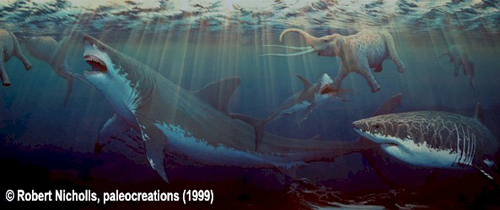
No, not The View. Not even Matt Nisbet.The new crown for most powerful bite force appears to belong to the Megalodon, an extinct species of gargantuan shark that grew to more than 50 feet long and weighed up to 110 tons. Early whales must have breathed a sigh of relief when Megalodon became extinct about 1.5 million years ago. Estimates suggest the toothy terror was at least 30 times as heavy as the largest of its living relatives, the Great White shark.
Technically speaking, megalodon (meaning "big tooth") is the species name for this juggernaut of a shark. But it's the preferred shorthand, given that a bit of a naming squabble is still playing-out over the genus name. When I was but a wee, aspiring marine bio lad, the shark was commonly called Carcharodon megalodon. The genus Carcharodon, meaning "sharp or jagged tooth" also happens to be the genus of the extant Great White shark (Carcharodon carcharias). Due to almost identical shape and arrangement of the teeth of the Great White shark and fossilized teeth of the megalodon, famed Harvard paleontologist and creationist Louis Agassiz proposed Carcharodon as the genus for megalodon as well.But appearances may be deceiving and convergent evolution can play tricks on the eye, claim a growing consensus of vertebrate paleontologists. Kevin Nyberg (formerly at Duke University) and others say the similarity is merely superficial and that modern Great White's originated from an extinct group of Mako sharks and not from the megatoothed giants. Some paleontologists have proposed the genus, Carcharocles, as a more accurate lineage suggesting that the direct ancestor of the megalodon shark is an ancient shark called Otodus obliquus, which lived during the Paleocene and Eocene epochs. O. obliquus gave rise to Carcharocles aksuaticus, and then a whole slew of Carcharocles intermediaries on the way to Carcharocles megalodon.
Confused yet? Classification wonks can head here if you absolutely must know more about the megalodon naming debate. But back to bite strength.
In a report published last week by the University of New South Wales in Sydney, Australia, researchers suspected that previously published values for maximum bite force of Great White sharks was greatly underestimated. They discovered that previous bite force tests were performed on small bait prey or using materials which likely caused the sharks to "hold back" on full bite delivery. Correcting for this in their new bite tests, researchers also performed elaborate CAT scans (above image) and digital recreations of a great white shark bite musculature (left). They found that the largest great whites have an astounding bite force of up to 2 tons."That is more than three times that of the bite of an African lion and more than 20 times that of a human. It's the biggest bite force known for any living animal so far, although it's certainly possible that the killer whale or possibly the larger crocodiles have more powerful bites," reported Stephen Wroe, a biomechanist and paleontologist at the University of New South Wales.
Based on presumed similarities of jaw mechanics, researchers hypothesized that megalodon exerted a bite force six to ten times stronger than the Great White. That surpasses the estimated 3.1 metric ton bite force of Tyrannosaurus rex by a good stretch.
Wroe and his colleagues will detail their findings in a forthcoming issue of the Journal of Zoology.
Marine Debris Threatens Everyone... Even Scantily-Clad Mermaids
The National Marine Sanctuary Foundation launched a new ocean health awareness campaign today. They've dusted off the characters from Disney's perennial favorite The Little Mermaid to educate the public of the hazards of marine debris.Head over to their campaign site to play games, send e-cards and learn how marine debris impacts the ocean from surface to bottom. They also have a page dedicated to TV and radio PSAs. Great messages to remind young and old to protect what's Under the Sea.
Breaking News: Grasshoppers Swarm Maryland & Delaware Beaches: Tiny Bottles Of Sunblock Scarce
Hold on to your Old Testament, folks. Bloggers on the East Coast are chatting about a grasshopper invasion that occurred this past weekend on the beaches of Fenwick Island, DE and Ocean City, MD. One blogger described "hundreds [of grasshoppers], in the water, washed up on the beach and hopping on the beach in the sand, on people, on chairs, umbrellas, etc. Very weird."SwellInfo, an online surfer forum, also reported strange grasshopper aggregations. In keeping with true surfer zeitgeist, the dialogue of Q&A on SurfInfo is priceless:
Comment 1: "I was wondering if anyone knows why the beaches have been plagued with grasshoppers? They are floating in the ocean and taking over the beaches. Yesterday on the beach was like grasshopper D-day. My bro was on the beach 2 days ago and said he didn't see a single grasshopper, and now you cant walk 10 feet without one trying to jump on you. Kinda cool, really weird."
Comment 2: "Yeah dude, my dad was on the beach yesterday and was telling me about this. said it was the weirdest thing he has ever seen."
Comment 3: "That is creepy man. I cant deal with bugs, they really give me the chills especially spiders or anything that jumps."
And so on.
Adding to the intrigue, I received an email on Scuttlebutt, the National Marine Educators Association list serve with the following, "My family and I also experienced the grasshopper invasion from the water to the beach and onto us and everything around us... [I] cannot wait to find out what the story is about the grasshoppers. We have been coming to Ocean City for 32 years and have never seen this happen before."
Grasshoppers were described as being seen "floating on their backs on the waves" and boogie boarders ran into them repeatedly before they arrived on shore. One blogger commented that there were, "hardly any seagulls around (normally there are tons) to eat the grasshoppers... Is something environmental, weather-related phenomena or possibly an omen?" Of the images I've so far seen posted on the web, I have a hard time convincing myself I'm seeing a "swarm" of grasshoppers. Sure, there are a few in the picture at the top of the post, but hardly biblical (or ominous) proportions. Anyone have other pictures that depict more than just a "few" grasshoppers?
Mass hatching? Grasshopper migrations? Or maybe grasshoppers just enjoy a day on the beach too? Can't really say from here. But damn if this doesn't look like a job for Doug Taron!
Get Out And Vote!
My thanks to all who have cast their votes on my poll (over on the left column) as to whether or not I should cast aside my fears and partake in a Black Water Night Dive with Jack's Diving Locker during my free time in Kona. Early results are interesting, but I'd like to see if I can raise my "n" a bit more--purely for statistically valid reasons, of course!So, take a second and vote over on the left side of this post. Poll questions are also below for easier reading. Your vote could be the difference between a happy Hawaiian experience, or my dangling by a rope ladder from the helicopter with a shark attached to my leg!
SHOULD RICK FACE HIS FEARS AND GO ON A BLACK WATER NIGHT DIVE WHILE IN KONA, HAWAII OR SHOULD HE LISTEN TO HIS INNER SCAREDY-CAT VOICE AND JUST DRINK MAI TAI'S ON THE BEACH?Hat tip to Jives for the above image--which I tailored.
You've got nothing to worry about, you big baby! Don't miss out on a once-in-a-lifetime opportunity!
While somewhat risky, I think you should still do it! If the worst happens I'll donate to CORAL in your memory.
You should do it, but if you're really concerned you probably won't enjoy the experience.
Drifting in deep water at night on a leash in pitch dark? Are you nuts?
Drink a few Mai Tai's, then do the Black Water dive.
Thursday, August 07, 2008
Should I Or Shouldn't I?
Just to refresh your memory, the dive goes like this: You head out at sunset into deep pelagic water off the Kona coast, suit-up, tether yourself to the boat on a weighted leash, and drop into inky black water to about 60 feet. That's it. Then, with tiny flashlight in hand, you simply drift through the black looking for amazing gelatinous zooplanktonic wonders to rise from the depths and pass by your mask. Sounds like a dream, but for the nagging feeling that I'm just glorified bait on a line for a hungry or curious Tiger shark, Oceanic Whitetip shark, or the uncommon (though not impossible) Great White encounter.
I know, I know... I'm more likely to get killed by a pig than a shark. But that's only if I'm hanging out on pig farms. I don't tend to do that. And I'm more likely to get struck by lightning. But only if I'm roaming about in the open during an electrical storm. Again, not something I tend to do. But if I go on the Black Water dive, I'd be bobbing about in open water at night--when big pelagic predators are most active. Isn't that raising my risk? Am I sensible to have some alarms going off? Or do I watch too much Shark Week?
I do a lot of finger pointing at folks who take stupid risks, then complain about horrible outcomes. I'd hate to have to include myself in that cohort. So in an effort to get a sense of what my readers think, I'm launching a poll. Check-it out in the upper left column below the About Me section. I leave in a week for Hawaii, so let me know what you think.
Monday, August 04, 2008
Great Ocean Blogs
I don't say this nearly enough, but I'm an enormous fan of all my ocean blogging colleagues. We are a small (but growing) cohort of the science and nature blogosphere, yet we are providing great content on ocean exploration, basic and applied ocean sciences, marine conservation, natural history, human impacts and interactions with the ocean, ocean art, music, poetry and much more. I've had the very good fortune to meet many of my ocean blog colleagues in person, moving our social network from virtual to actual. Were it not for blogging, I'd now be unable to call people as scattered as The Beagle Project's Karen James, inverte-brat Kevin Zelnio, deep sea coral scientist Peter Etnoyer, and ocean techno-wizard Jason Robertshaw, my friends. And there are a bunch more of you I look forward to meeting eventually (Mark, with all the traveling we do there must be a way we can at least pass each other in an airport!) If we can entice and cultivate more ocean bloggers, perhaps it may be time for our own ocean blogging conference so we can do our much beloved ocean (and interests in ocean communication) justice.
Carnival of the Blue is one way to stay on top of some of the best ocean writing each month. But I've compiled a list of some of my favorite ocean bloggers whom I read daily. Is it a definitive list of all the ocean blogging out there? Certainly not. It's just a very idiosyncratic collection of blogs that I can always count on to make me think, laugh, write, or take action. So pay a visit to these great blogs and see why they should be part of your minimum daily requirements for ocean aptitude:
Uma Malla pelo Mundo
Portugese for "A Net Around the World," Lucia Malla's take on ocean conservation.
Blogfish
Mark Powell and Kate Wing comment on sustainable fisheries and other ocean conservation issues.
Cephalopodcast
Jason combines his love for oceans with his love for teaching in every post.
My Favourite Places
Pepijn Koster covers all things ocean and all things LOL cats.
The Oyster's Garter
Miriam Goldstein and Eric Wolff, marine biologist and journalist, two great minds that work great together.
The Natural Patriot
Emmett Duffy conducts research and dives on tropical reefs so you don't have to.
The New Blue
Ocean news and opinions from Jives at The New England Aquarium.
MNS Marine Group
Marine conservation, coming at you from Malaysia
Maribo
Coral scientist Simon Donner provides thoughts on the intersections between climate change, policy, and human welfare.
Climate Shifts
I'll say it again, my one stop shopping for climate change news, views and overall round-up of politics and the environment by Ove Hoegh-Guldberg.
The Annotated Budac
Budac is Malaysian for
I'm a Chordata, Urochordata!
Jarrett Byrnes (like Miriam Goldstein, a lover of ascidians) serves up ocean science through his excurrent siphon.
Pulau Hantu
More Singapore natural history with amazing images.
The Tide Chaser
Who knew Singapore's heavily industrialized Changi Harbor had so much life? Tide Chaser's knew!
The Beagle Project Blog
If the technology existed then, Darwin would have been an ocean blogger! Ask Karen James and Peter McGrath.
Manta Blog
Yet more intertidal beauty from Singapore.
WaterNotes
Green-Marine-Conservation is Sarah's mantra.
SeaNotes
Alison Barratt and others bring you ocean voices from the Monterey Bay Aquarium.
Siham Is Alive
How's your Bahasa Indonesian? You'll need it for this blog from Java.
Team SeaGrass
Yes, still more ocean blogging from Singapore!
The Radula
While not a strict "ocean blog" per se, when Dorid does write about the ocean, it's always with passion.
from Archaea to Zeaxanthol
Jim Lemire teaches and blogs from Roger Williams University in Rhode Island, whose undergrad marine bio program produced yours truly (it wasn't their fault).
The Other 95%
What would ocean blogging be without Kevin Zelnio? Probably a lot more sober, but also a lot less fun! Even more spineless offerings now that Eric Heupel's on board,
Shifting Baselines
Jennifer Jacquet calls her blog a "writing lab." I call it thought-provoking reading.
The Saipan Blog
Again, not strictly ocean, but the best conservation blog coming out of Micronesia.
Deep Sea News
Craig, Peter, and Kevin are deep guys. And they know it.
Beach Chair Scientist
Ann McElhatton takes Q&A to a whole new level with a blog just perfect for students and teachers.
Blue Ventures
Find out what marine conservation and science looks like in Madagascar.
Coral Bones
Caspar Hendersen posts here less frequently, yet previous posts provide a reality check of the current coral crisis.
WATERlog
A blog from the National Aquarium in Baltimore takes on ocean education, science, and conservation.
Labels:
blogging,
Communication,
Community,
Social Networks
That's A Moray Monday
With this week's post I'm back to my regular tally of amazing moray eel diversity. I've decided to show some local California favoritism for the Golden State I call home. And how better than through a post dedicated to one of California's native (almost endemic) species.California Moray
Gymnothorax mordax
I LOVE the scientific name for this moray species. I won't pretend competency in classical Latin or Greek etymologies, but from what I gather from a few references the species name, mordax, is Latin for "prone to biting." The California moray is found in the eastern Pacific from Point Conception in California to southern Baja California in Mexico. I say it's almost a California endemic since sightings have also been documented as far south as the Galapagos Islands. Despite the extended range, it still goes by the common name California moray--same goes for all those California sea lions (Zalophus californianus) so ubiquitous across the Galapagos).
The California moray reaches a maximum length of up to 152 cm. (almost 5 ft.) It is commonly found among rocks, in crevices or holes, usually with only its head protruding. It is very common in shallow reef areas, feeding mostly at night on crustaceans, octopuses and small fishes.
While G. mordax won't be winning any beauty contests, the species appears to have some variability in coloration and markings. Smaller specimens (juveniles?) appear more yellowish in color, while larger specimens exhibit darker, more olive-brown or rust coloration. Large and small specimens have prominent lighter-colored speckles and spots that seem to run the length of the body.The California moray is quite often seen in association (see below image) with another California endemic, the Lined or Red Rock shrimp (Lysmata californica). On a few frigid dives just south of Monterey, California, I've watched big California morays rest passively out of their rocky holes, mouths agape, as these little shrimp perform some impromptu dentistry, cleaning away bits of accumulated food, slime, or dead skin from between the moray's impressive teeth.
Damn You, Jason Robertshaw!
Be warned. Spending time with Jason--he of the remarkable blog Cephalopodcast and other online wonders--is a sure way to put a dent in your wallet. His fascination with technology is contagious! Case in point: Jason was flashing this cool micro digital video camera when we were at the National Marine Educators Association conference in Savannah. It's called the Flip Mino by Pure Digital and it's too cool for school. Tiny, 2 gigs of memory, 60 minutes of record time, USB connection built-in, and it syncs seamlessly with Apple applications or you can use its on-board video software. What more can you ask for to add simple, pocket-sized video to your website or blog?
Thanks for the heads-up on this, Jason. I hope to start adding my own video to MBSL&S in the very near future.
Saturday, August 02, 2008
Montauk Monster All Washed Up?
The story's so good that CNN just had to jump on the bandwagon:
Bloated, decomposing cryptid on a beach? Who ya gonna call? Well, CNN's Wolf Blitzer called-in Jeff Corwin, Animal Planet celeb and gloriously self-promoting zoologist to comment on the beastie. "Looks like a decomposing dog," reported back Corwin. But before a necropsy could be performed, the carcass mysteriously disappeared from the scene.
Mystery unsolved? Not quite. New images surfaced this weekend of the Montauk Monster from a few different angles. Suddenly the "beak" looks a lot less beak-like. The blog Tetrapod Zoology has provided a detailed analysis that sure makes it look reasonable that the Montauk Monster is more precisely called Procyon lotor, or the North American raccoon.
Just as observers claim to see faces of Elvis in tree bark, decomposition can create opportunities for pareidolia and misidentification. The Montauk Monster is only the latest of a long pedigree of washed-up, decomposing critters that have been mistaken for "sea monsters." Strangemag, the online version of Strange Magazine, calls these mystery lumps of flesh "Globsters." As a fan of ocean cryptid news, I have a file of some true classics.There's the "Plesiosaur" that washed ashore on Moore's Beach in Monterey Bay, California in 1925. This cryptid sported an alleged seven meter long neck. Some witnesses even described a number of legs on the creature. The remains were soon identified as a beaked or Baird’s whale (Berardius bairdii). It's "seven meter neck" is actually just a section of the spinal column surrounded by connective tissue which has been both eaten away by other animals as well as decomposed.
During the night of November 16, 1970 this approximately 16 meter creature washed ashore in Scituate Harbor, Massachusetts. Again, decomposition created the illusion of a long, plesiosaur-like neck. Closer analysis identified this Massachusetts monster to be a Basking shark (Cetorhinus maximus).
Seems as though our oceans are simply overflowing with rotting plesiosaurs! Yet another plesiosaur carcass was snagged in fishing nets off the coast of New Zealand in 1977 by a Japanese fishing boat the Zuiyo Maru. This specimen measured nearly 11 meters in length and weighed two tons. The carcass reportedly gave off a strong ammonia stench and was quickly discarded after being photographed. News reports focused on the long "neck" and apparent plesiosaur "paddles." But again, the specimen turned out to be a heavily decomposed Basking shark. It's paddles merely the cartilaginous remains of its pectoral fins.
In March of 1969, thirty-five tons of something big and dead washed ashore on a beach in Tecoluta, Mexico. The international press reported that a "prehistoric monster of some sort had been beached and the world awaited further word on the carcass." That word wasn't long in coming when one month later a seven-man commission of scientists reported that the monster was a Fin whale (Balaenoptera physalus).
Will the new Montauk Monster join the pantheon of great, non-sea monsters? I'm skeptical. I think if that poor bloated doggy had a few more weeks of decomposition, then it could have been a contender. But a pseudo-beak just isn't doing it for me. Still, it's gotten way more air time than all of the above cryptids combined. So who knows. Besides, the next "monster" is just a high tide away.
SF Aloha Festival 2008
San Francisco has a lot of annual street fairs across the city, but they all tend to look and feel the same... same food, same vendors, same music, same crowd. But Aloha Festival is truly unique as it's the only Bay Area gathering that celebrates Pacific Island cultures. I saw celebrants from as far as Fiji, Tonga, Guam, Samoa, and Palau, and of course plenty of folks representing the Hawaiian Islands.
CORAL once again has a presence in the festival's education tent to spread coral reef conservation messages to participants. That's CORAL staff Anja Mondragon and Elizabeth Curran spreading some Aloha spirit.
Subscribe to:
Posts (Atom)