Got 20 minutes? Go spend it wisely and get the whole story at The Story of Stuff.
Monday, March 31, 2008


That's A Moray Monday: The Baby Pictures Edition
 Since last Monday was abuzz with Pharyngula-driven traffic on the whole Expelled brouhaha, I didn't get around to posting a Moray Monday. So I thought I'd make up for it with today's special edition focused on the early life stages of moray eels. Turns out morays aren't just cool as adults, they're pretty awesome as babies too.
True-eels (Anguilliformes) along with the closely allied tarpon (Megalopidae), bonefish (Albulidae), and ladyfish (Elopidae) produce larvae known as leptocephali. These transparent, ribbon-like larvae drift as part of the planktonic community as they develop. Interestingly, Muraenid (moray eel) leptocephali possess pectoral fins, a condition wholly different from that of the adults. It is during the transformation from leptocephalus to juvenile that the pectoral fins are resorbed.
Moray eels, like all true eels, are oviparous--or egg-laying. Although little is known regarding moray spawning, fecundity and early development of the leptocephali, one published source records numerous ripe eggs measuring 1mm in diameter from a 1.1 meter female. In contrast to this single record other sources indicate a much larger size for the eggs of other morays, on the order of 3-4mm in diameter. Interestingly, marine aquarists may have more direct experience with moray egg production than the research science community. I found posts on at least two online aquarist discussion boards about discovering egg masses in tanks housing Zebra morays. It's all anecdotal and no images were provided, but it's reasonable to assume this sort of thing does occur in captivity.

(Fishes of the North Atlantic, 1989)
 When the fertilized eggs of morays hatch, prolarvae emerge. Shortly thereafter the prolarvae transform into leptocephalus larvae, which grow to be between 5 and 10 cm in length. Leptocephali of the various species of moray in general are distinguishable by patterns of pigment, the number of trunk muscles (known as myomeres), and the position of the dorsal fin and the anus. The myomeres of a leptocephali can be clearly seen in the specimen in the image to the left (click image to enlarge).
 The leptocephalus shares a number of morphological characteristics with its adult counterparts: both are long and laterally compressed and their dorsal, caudal and anal fins are continuous. Unlike adults, they have a "gelatinous" consistency and their tissues (with the exception of bone) are transparent. The leptocephalus larva will undergo its final metamorphosis in open water. Except with regard to size, the juvenile resembles the mature animal. Ocean currents disperse the animals after metamorphosis and, once they have reached a permanent habitat, they mature.
 While not apparently practiced with moray larvae, the leptocephalii of the Japanese conger eel is eaten seasonally in the markets of Shizuoka, Okayama, Misaki, and Wakayama Prefectures. Known as “Noresore” (のれそれ), the baby conger eels are 5-6cm in length and resemble long transparent noodles (save for their eyes). At sushi counters, they are served with freshly grated ginger and chopped green onions. At some restaurants, they are served live to the table and eaten live after dipping in sweet fish sauce mixed with vinegar.
Who am I to critique? I eat hotdogs.
Sunday, March 30, 2008
The Material Girl Is The New Green?
 Inexplicably, Madonna graces the cover of Vanity Fair's third annual Green Issue on sale tomorrow. I totally got their first green issue cover with Al Gore, George Clooney, and a few other environmental glitterati.
 And last year's issue featuring then adorable polar puff ball Knut the polar bear (and equally adorable Leo diCaprio) also made sense.
 But Madonna? Have I missed something? Isn’t this the same Madonna who spends $120,000 a year on bottled water? Perhaps the mistress of reinvention has found a way to wrap herself in green for a little strategic marketing well-timed with the release of her new album?
Regardless, I'm looking forward to Michael Shnayerson's story on the Selling Out of Polar Bears.
Saturday, March 29, 2008
Ribbon Seals May Join Polar Bears As Soon To Be Homeless
 The National Oceanic and Atmospheric Administration's National Marine Fisheries Service, acting on a request by the Center for Biological Diversity, agreed last week to determine by the end of the year whether the little-known Ribbon seal (Histriophoca fasciata) should be listed under the Endangered Species Act. The consideration for protection is based on imminent threats from the effects of arctic habitat loss due to climate change, as well as threats from hunting, and environmental contamination due to oil and gas development and production. Commercial fishing and climate change may also be affecting the food supply of the Ribbon seal.
In a statement issued last Wednesday, Brendan Cummings, the Center for Biological Diversity's oceans program director, said the Ribbon seal's winter sea-ice habitat is projected to decline 40 percent by midcentury under greenhouse gas emissions models. "Any remaining sea ice will be much thinner and unlikely to last long enough for Ribbon seals to finish rearing their pups, leading to widespread pup mortality," Cummings said.
 Looking a lot like the Belted Galloway of the sea, Ribbon seals live in the Arctic parts of the Pacific Ocean. During winter and spring, they haul-out on pack ice to breed, molt, and give birth. During this time, it is found at the ice front in the Bering and Okhotsk Seas. During the rest of the year, Ribbon seals live in open water. Because the Ribbon seal is often so far from land and human observation, little is known about their habits.
Its diet consists almost exclusively of pollock, eelpout, arctic cod and cephalopods such as squid or octopus. Unlike many other pinnipeds, the Ribbon seal is solitary and does not appear to congregate in colonies or herds.
Friday, March 28, 2008
My Gayest Look For Jay Leno
 On Thursday, March 20, 2008, Jay Leno welcomed as his guest on The Tonight Show the actor Ryan Phillippe, who, early in his career, played a gay character on the daily soap One Life to Live. During the interview, Leno hounded Phillippe, telling him to look into the camera, pretend it was his "gay lover…Billy Bob," who "has just ridden in shirtless from Wyoming," and give it his "gayest look." Phillippe's understandably uncomfortable answer: Wow. That is so something I don't want to do.
Watch the video:
 In response, Avenue Q playwright Jeff Whitty (who has had previous homophobic run-ins with the unfunny late-night comedian) penned a letter to Leno about his homophobic humor and included a photographic sign-off (left) of his "gayest look." Melissa McEwan of Shakespeare's Sister added her own and invited others to join in sending Leno their "gayest look" too.
As Melissa comments, "A 2005 study by GLSEN found that 90% of LGBTQ teens had been harassed or assaulted during the previous year. They were three times as likely as non-LGBTQ students to say that they do not feel safe at school and remain at increased risk for bullying, assault, and suicide. That doesn't happen in a void. Gay jokes are not harmless; they contribute to a culture in which institutionalized homophobia has tragic consequences."
So I've decided to join an impressive and growing list of folks who have had it up to here with this cro-magnon-jawed tool and I'm offering my own gayest look (above) for Leno. Feel free to send him your own.


A Call To Mercy
 The legalized annual seal slaughter in the Gulf of St Lawrence and around Newfoundland has this year been set by the Canadian government at 275,000 harp seals, out of a herd of more than 5.5 million, as well as 8,200 out of 600,000 hooded seals. Canada's commercial seal cull by fishermen--who harvest the creatures for their pelts, blubber and meat--is the world's largest hunt for marine mammals. Sealers and the fisheries department defend the hunt as sustainable and well-managed, and say it provides supplemental income for isolated fishing communities that have been hurt by the decline in cod stocks.
Much of the protest against the hunt has focused on methods used to kill the seals--killed either with a spiked club, or haakpik, or a rifle. Groups like Greenpeace have filmed seals being skinned while still alive. This year, hunters will take an extra step to make sure the seals are dead before skinning them. Hunters will be required to sever the arteries under a seal's flippers, a recommendation made in a European Union report released in December.
Believe me, I wear no rose colored glasses. As I type these words, amazingly inhumane practices are business as usual in slaughterhouses all across the USA. There are brutalities in animal management that play out daily in everything from poultry to beef factories. It was just a few months ago that we were privy to images of a worker on a forklift ramming a sick cow during the last beef recall. The industrial meat production world needs to clean-up its act as well. But perhaps the seal hunt provides a lens to reflect on our treatment of animals--something which we've somehow managed to insulate ourselves from.
And the brutality is a big part of my issue with the seal hunt. It's not the sustainable harvest of a species for food that I find unacceptable (though I think that argument is a canard), it's the method of dispatching them and the potential suffering these animals endure that's hard to stomach. The hunt should not just be sustainable, it should be humane. Clubbed, shot, and bled to death before skinning just doesn't strike me as meeting that call. And what's it all for? Claims that seal meat is feeding multitudes of indigenous Canadians practicing centuries-old traditions just doesn't hold water. According to Matthew Scully in Dominion, the real spoil of the hunt is fur that is sold to international furriers for luxury coats. The remainder, mostly leather scraps, are used for gloves, briefcases, wallets. The penises of adult seals are sold to Asian markets, where they are ground and used as aphrodisiacs. This product line justifies such brutality? We're not curing cancer with the hunt, so let's stop pretending like it's utterly indispensable.
I think it's fair to wager that a seal is at least as intelligent as a dog. I don't see one catching a Frisbee anytime soon, but from what I've seen of trained seals in captivity some can certainly do a lot more than Fido. They demonstrate curiosity, can learn, and form complex social bonds. No decent human would want to see their pet dog suffer. The thought is almost painful. Why, then, should we be so inured to the suffering of another similarly intelligent animal? Is it because the suffering is silent and out of sight?
I know I run the risk of getting tagged as some sort of extremist seal-hugger with this post, but I feel HOW we choose to hunt is as important to consider in sustainability as WHAT we choose to hunt. And while kindness to animals may not be our most important duty as human beings, it should certainly not be treated as our least important. Clubs with skull-piercing metal hooks that often don't kill immediately is humane and the best we can do? And "tradition" should trump our humanity and compassion?
Sorry, my cultural relativism has limits.
Thursday, March 27, 2008
Wyland Will Attend The Opening Of An Envelope
 Yeah, yeah, yeah... I know I'm supposed to be all united behind the ocean conservation banner, but the "artist" Wyland truly makes me gag. Robert Wyland, known simply as Wyland, is best known for taking perfectly wonderful blank walls and transforming them into large, garish outdoor murals of whales and other ocean life. And Wyland is nothing if not a shrewd businessman. Like Starbucks and McDonalds, you can't visit a major city or island destination on the planet without finding at least one Wyland gallery peddling his pricey wares of paintings, statues, mugs, candles, t-shirts, and more. And honestly, $16K for a Wyland original?! Really?
Most of Wyland's pieces have that electric kool-aid acid trippy look going on, and there's something annoyingly anthropomorphic about a lot of his mammal interpretations. But apparently I'm an outlier in my opinion, because people appear to just eat this shit up. I mean, good grief, there's actually a new hotel on Oahu, the Wyland Waikiki, committed to providing guests with the full Wyland experience. What fresh hell is this?
 But wait, there's more. Wyland was one of the guests at Monday's annual White House Easter Egg Roll in Washington. He joined a distinguished roster of other cartoon characters including The Cat in the Hat, Tweety Bird, Charlie Brown, Clifford the Big Red Dog, and the Official White House Easter Bunny. I admit being pleasantly surprised to hear that ocean conservation was the theme of the day. First lady Laura Bush noted the event featured an ocean conservation education area where visitors could "learn what you can do to make sure we keep our oceans clean and healthy for fish and other ocean life." And you guessed it, Wyland was on hand to offer painting lessons to the gathered children and no doubt cultivate future repeat customers.
Maybe he's raised ocean awareness and excitement for conservation. I'm not criticizing that. But when a genre becomes so ubiquitous, mass produced, and commercial doesn't it lose some of the allure that might have made it special in the first place?
Fish Of The Day
 The gorgeous fish in the above image is an Asian arowana, Scleropages sp., also known as the Asian bony tongue, dragon fish, and a number of other common names specific to different color morphs. Native to Southeast Asia, Asian arowanas inhabit slow-moving waters flowing through forested swamps and wetlands. Because of their spectacular color and form, they have become popular aquarium fish. They also have special significance in areas influenced by Chinese culture. The name dragon fish stems from their resemblance to illustrations of Chinese dragons. Asian arowanas are considered "lucky," particularly since the Chinese dragon is an auspicious cultural symbol.
 Unfortunately, this alleged luck isn't holding out for the fish itself. It's dragon-like resemblance and popularity has come at a cost to the species survival. Asian arowanas are listed as endangered by the 2006 IUCN Red List. And the Convention on the International Trade in Endangered Species of Wild Flora and Fauna (CITES) placed them on Appendix I, the most restrictive category. While over harvesting is in part to blame, habitat destruction is the primary threat. All of this hasn't put a damper on the demand for the species as an aquarium fish. Its popularity has in fact soared, and aquarists may pay thousands of U.S. dollars for one of these animals. Captive-bred arowanas are allowed under CITES, provided their origin as a captive-bred specimen can be verified through documentation.
Why my recent interest in Asian arowana? Well, the SF Cronicle reports today that a local San Francisco man will be spending the next four months in home confinement for selling an Asian arowana in July 2004 to an undercover U.S. Fish and Wildlife agent on an Internet site called Aquabid. The perp--Danny Yep, 27--was also fined $2,000 and placed on three years' probation. The Chronicle reports that Yep pleaded guilty in December to a felony count of violating the Lacey Act, which makes it illegal to sell an endangered species. He admitted that he knew the fish was listed as endangered and that both the importation and sale of the fish were illegal.
 Meaningful punishment that can serve as deterrent or slap on the wrist? Maybe neither. I suspect the heat now has to also get turned-up on the in-country end of the supply chain--those who are actually capturing the wild fish for the aquarium trade. Fish farms have proven to be successful conservation approaches for some aquarium species, though start-up costs are often the limiting factor to their implementation. But with some strategic microloans from governments or NGOs to get the operations up and running, it shouldn't be too difficult to get a solid return on investment when consumers are willing to shell-out $3000 for a quality specimen.
Wednesday, March 26, 2008
Life's Not Always Beer And Skittles
 I just got the unfortunate news today that a fairly substantial grant pre-proposal I submitted to the National Fish and Wildlife Foundation (NFWF) is not being waved in for a full proposal. Damn it!
NFWF has historically offered funding for one-year projects up to $50,000. We've been doing quite well over the past few years at securing these grants. But for 2008, NFWF launched a new funding category for their coral reef conservation programs that allowed for multi-year projects (up to three years) and up to $300,000. I submitted a pre-proposal that builds on our previous multi-year conservation investments along the Mesoamerican Barrier Reef. With the required 1:1 federal match, the project was about half-a-million dollars over three years.
It's great to see funders like NFWF ramp-up their funding and recognize that conservation is an ongoing investment and takes time to build capacity and meaningful results. I'll just have to work on an even more killer proposal for next year.
Tuesday, March 25, 2008
Top 5 Best Reasons For A Mariana Trench Marine Monument
 As mentioned earlier today, my Saipan colleague Angelo Villagomez is leading the charge on the creation of a new marine monument in the Commonwealth of the Northern Mariana Islands (CNMI). The proposed monument would in part recognize the significance of the Mariana Trench, which at a depth of 6.8 miles is the deepest part of the world's oceans, and the deepest location on the surface of the Earth's crust.
I'm certain Angelo will be providing plenty of impressive justifications for the creation of this marine monument over the course of 2008. But here are my top five reasons that a Mariana Trench marine monument would be kick-ass:
#5
It's most likely the home of the Cloverfield monster

#4
Amazing economic opportunity in designing and marketing line of exclusive Mariana Trench Coats

#3
Mariana Trench provides convenient access to Earth core in event that mantle circulation needs jump start, a la The Core

#2
Lots of free press on trench science from

And #1
Risque yet successful tourism advertising slogan with, The CNMI: You'll Love How Deep We Go

A Micronesian Challenge Indeed
 Angelo over at the The Saipan Blog forwarded me a map of a newly proposed marine monument that could go a long way at preserving ocean biodiversity for the Commonwealth of the Northern Mariana Islands (CNMI). The proposed "National Park of the Sea" encompasses a slice of the Mariana Trench and the three northern islands of Asuncion, Maug, and Uracus. Angelo thinks that if achieved, the monument can be an excellent opportunity for the CNMI to improve its economy while also protecting local culture and natural resources.
This proposal for a new marine monument is following in the same footprints as the Northwestern Hawaiian Islands when they were re-designated last year as the Papahānaumokuākea Marine National Monument. It encompasses 362,000 square kilometers of the Pacific Ocean (105,564 square nautical miles)--an area larger than all the US national parks combined.
Papahānaumokuākea was created by Presidential proclamation on June 15, 2006. While it was supposed to be the biggest marine protected area on the planet and serve as an enduring marine conservation legacy for both President Bush and the United States, it was quickly surpassed in late January 2008 when the Pacific Island nation of Kiribati doubled the size of its Phoenix Islands Protected Area creating the world's largest MPA at 410,500 square kilometers.
Supporters for a new 295,000 square kilometer CNMI-based marine monument may have an uphill struggle as there is a lack of support from the local government for its creation. House Speaker Arnold Palacios has strongly spoken out against having the northern islands in the CNMI turned into a marine national monument. Governor Benigno R. Fitial has also gone on the record to oppose the designation at this time. Which immediately makes me wonder about existing fishing interests within the proposed monument waters and whether certain powerful lobbying efforts against protection are underway.
Hmm, I wonder who might not want to see fishing limits in CNMI waters?
Another consideration that's worth vetting on the part of monument supporters is how to strengthen sustainable marine tourism should the monument become a reality. Believing in a "if we build it, they will come" mentality is not enough to create incentives for tourism's sustainable growth. American Samoa has a National Marine Sanctuary and stunning reefs under national protection yet has almost no tourism infrastructure. As a result, unless you pack your tank for a trip there (on the one plane a week that flies to American Samoa from Honolulu) you're not going diving. This isn't a formula for new economic prosperity from tourism.
Despite the challenges, the Pew Environmental Group and local NGO Beautify CNMI have commited themselves to outreach and education on the benefits of the proposed monument. Angelo (as reported in the Saipan Tribune) said presentations on the marine monument proposal will be shown to whoever is interested in learning more about it.
Just let me know how I can help, Angelo!
Outwit, Outplay, Outlast
 See that tuna in the image above? That's me, and I'm doing my best to survive the many real-world perils from overfishing so I can pass my hardy tuna genes on to the next generation.
 It's all part of "Ocean Survivor," a new online game that's being unveiled by the Pew Environment Group on ocean and fishery conservation. The game is designed to draw attention to overfishing and provide visitors with an opportunity to sign a petition to make a difference. Head on over and play the game and sign the petition. It's easy and it's fun!
Monday, March 24, 2008

Performing My Civic Doodie
 I've already deferred twice, so today has me catching-up on my reading while sitting in the Alameda County Courthouse on a jury summons. Given the crime rate here in Oakland (and apparently the dearth of registered voters), I sometimes feel like I get called every six months. If I were allowed to bring a computer, you bet your ass I'd be blogging from the courthouse.
Hope your day is more enjoyable.
Sunday, March 23, 2008
It Really Is Better To Give Than To Receive
 Contrary to what you might initially think, giving away your money feels good. A ScienceNow report from last week shows that it's not how much you have that matters, it's how you spend it. People who donate their dollars to charities or splurge on gifts for others are more content than those who horde their riches or spend it on self-indulgent splurges.
Psychologist Kathleen Vohs, with the University of Minnesota in Minneapolis, says she started thinking about the psychology of money when she moved from a postdoctoral position to her first faculty job. The big salary increase meant she could hire a mover instead of relying on help from friends. While it certainly made the move easier, Vohs said that she missed the camaraderie of sharing pizza and beer after a big group effort. The experience led her to hypothesize that while money makes people more independent, it can also act as an isolating social barrier.
To gather evidence for her hypothesis, Vohs collected data on income, spending, and happiness from 632 people across the United States and also recruited several hundred college students to participate in a variety of experiments. In all data sets, happiness correlated with the amount of money people spent on others rather than on themselves or the absolute amount of work-related bonus or income. Vohs speculates that the effects of altruistic spending are probably akin to those of exercise, which can have immediate and long-term effects. Giving once might make a person happy for a day, but "if it becomes a way of living, then it could make a lasting difference," she says.
Not surprisingly, this study is already making ripples outside of behavioral psychology circles. Which is of course music to the ears of those of us who rely on philanthropy for our survival. The Coral Reef Alliance (yes, this is a gratuitous plug) is a member-supported, non-profit organization, dedicated to protecting the health of coral reefs by integrating ecosystem-based management, sustainable tourism, and community partnerships. We're small, efficient, nimble, have tremendously low overhead, and devote the vast majority of our financial resources to direct site-based conservation work. And best of all, our efforts are demonstrating measurable gains in reef health and local community support for conservation.
 So allow me to help make you feel better by offering you a twofer. Click on over to CORAL's donation page and make an investment in conservation that helps us protect a critically threatened ocean ecosystem as well as the local communities that depend on healthy reefs for their survival. Send the link to a friend. Your financial contributions won't just fund important work, it will make you feel good too. It's win-win. So in the words of The Partridge Family: Come On, Get Happy!
Saturday, March 22, 2008
The First, Maybe-Annual, MBSL&S Spring Ocean Egg Hunt
 Since I plan to spend most of the weekend with my legs propped-up while eating milk chocolate bunnies, peanut-butter eggs, and other assorted bon-bons, I thought I'd give my faithful readers a little seasonal fun to keep you occupied. So here's the first, maybe annual Malaria, Bedbugs, Sea Lice and Sunsets Ocean Egg Hunt. The rules are simple: Accurately identify the dozen ocean animal eggs pictured above.
 And to all you smarty-pants types who would be quick to squash the fun, Yes, I know, some of these are "egg cases" and not the actual eggs. Yeesh, lighten up! It's a game.
The first person to accurately identify all 12 eggs gets a free copy of our fantastic book: Reef. How cool is that?! Precision counts, so try your best to narrow answers down to a species if possible.
Good luck and try not to OD on too much chocolate.
Thursday, March 20, 2008
Look Before You Leap
 I got an email this morning from Kevin over on The Other 95% to clue me in on a freakish accident that occurred today in Miami when a Spotted Eagle ray leaped from the water onto a boat, striking a 55-year-old woman and killing her. What are the chances? Turns out the ray knocked the woman down, causing her to hit her head which led to her death.
 This isn't the first ray-related collision on record. In 2006 (just a month after Crocodile Hunter Steve Irwin was killed after grabbing a giant stingray while snorkeling along the Great Barrier Reef) a Florida man was similarly stabbed through the heart by a Spotted Eagle ray that leaped onto his boat. However unlike Irwin who pulled out the ray's barb after being stabbed and possibly exacerbating the damage, the Florida man left the barb in place. Doctors were later able to carefully remove the barb in surgery, minimizing further heart damage. The man eventually recovered.
All of this got me to wondering what other leaping aquatic life might have my name written all over it. There have been a number of incidents on Florida's Suwannee River involving sturgeon and various human body parts. One particularly impressive collision between fish and human last year resulted in a broken leg on a six-year-old girl. In 2006, a woman was struck in the face by yet another (or the same disgruntled) sturgeon while boating on the Suwannee. She sustained facial injuries and fractures that required plastic surgery. In 2003 in St. Augustine, Florida, a fisherman was hospitalized after being bitten by a barracuda that jumped into his boat. What's with Florida fish?
A little surfing around YouTube found a few video gems as well. There's the amazing, jumping Asian carp near the Great Lakes:
An absolutely astounding video of a Great White shark high-and-dry atop a boat it landed on in South Africa:
A Tarpon that just can't wait to get to the taxidermist:
And a dubious video of an Orca getting up close and personal with a kayaker:
Not to be outdone by vertebrates, I've heard several anecdotal reports of Humboldt squid leaping onto the decks of sailboats in the Gulf of California, apparently attracted by deck lights on the boats at night. I couldn't find any images or reports anywhere on the net to confirm this. If any readers have info on jumping squid (or other aquatic life that's aiming for us) feel free to leave a comment.
And just to prove it's not just aquatic life that's going all Sopranos on us humans, here's a video of über-hunk Fabio getting whacked (in the face by a goose) while enjoying a rollercoaster ride:
Tuesday, March 18, 2008
Did I Pack My Pastel Jacket?
 I'm off to Miami for one day of meetings with all the coordinating partners of the Mesoamerican Reef Tourism Initiative (MARTI), a joint project of CORAL, Conservation International’s Center for Environmental Leadership in Business, and Cancun-based Amigos de Sian Ka’an. Our combined vision for change along the Mesoamerican Reef is to see tourism become a force for biodiversity conservation and sustainable community development. To do this we are engaging key sectors of the tourism industry — hotels, marine recreation operators, and cruise lines — to significantly reduce the industry’s environmental footprint and maximize its contributions to the protection of the Mesoamerican Reef.
I hate one-day trips like this that have me cross a continent and spew a massive carbon trail only to sit in a room for eight hours and then head straight back. Isn't this why Polycom was invented? Anyway, if anything interesting happens I'll be sure to share.
Monday, March 17, 2008
That's A Moray Monday: The Do-As-I-Say-Not-As-I-Do Edition
 Let's try a blind lead that seems very appropriate for Moray Monday.
What very vocal Hawaii dive operator who has gone on the record as being opposed to voluntary environmental marine recreation standards because (paraphrased),
We already have standards, are operating sustainably already, and have been taking care of the reef for a long time without any more rules!has a very curious and contradictory review from a customer on an online travel advice site,
I'm not the pro diver, but my husband is having logged almost 120 dives. All the recommended dive companies were booked out, so we took what was available. Christmas Eve we set off for Lanai (another of Hawaii's islands). The diver's weren't as expert as those you'd find elsewhere and the equipment wasn't brand new; but we really wanted to dive the Cathedrals - an underwater lava/cavern formation which is lit up by sunlight.While perhaps out of place to include on a moray post, the reviewer also posted this snap of divers harassing an octopus.The first dive was Sergeant Major. (Depth 61 feet/Bottom time 46 minutes). It was a bit of a calamity getting off the boat. There were a few who didn't seem to know how to dive, apparently they were just certified and didn't know how to deflate their BCs. Saw two white tipped reef sharks. The other group saw a moray eel. The photos were taken by the dive shop. This is the eel right before he bit into the hand of the dive instructor who later went to the hospital to get stitches. [Note: Above image illustrates results from a similar moray bite.] I guess he shouldn't have been playing with it.

 If this is taking care of Hawaiian reefs and demonstrating sustainability, I shudder to imagine what carelessness looks like.
Best Search Words, Evah!
 While visiting Harvard last summer at the tail-end of a conference, I blogged about fond memories of some of my favorite Cambridge stomping grounds. Perhaps my ultimate Harvard lore has always been the old chestnut that sex in Widener Library is de rigueur and a right of passage.
 Based on my Site Meter stats from today, apparently the lore is alive, and well, and still living in Harvard Yard. Thank you, ambitious and horny Harvardian, for giving me a chuckle. Hope you got your freak on. If memory serves, the study carrels near the 810 stacks of Literary History & Criticism have some good karma.
Friday, March 14, 2008
Can't We All Just Get Along?
 As if survival wasn't hard enough for coral these days, add another identified threat that's been getting a lot of chatter on the coral science and conservation listserves: inter-species competition.
 It seems a particular species of zoanthid (Palythoa caribaeorum) has been observed to be overgrowing living sclerectinian corals throughout the Caribbean. This sort of interspecific competition is nothing new to marine ecologists. Under certain circumstances, various epizoic organism are observed to overgrow living corals--the brown algae Lobophora variegata, the sponge Terpios hoshinota, zoanthids, some ascidians (e.g. Didemnidae), or the octocoral Erythropodium sp. Although epizoism per se does not represent a disease, what is of particular interest and speculation is how human induced nutrient shifts and global warming may induce booming reproduction of faster growing epizoic organisms by upsetting the existing balance and ultimately altering a once flourishing coral reef.
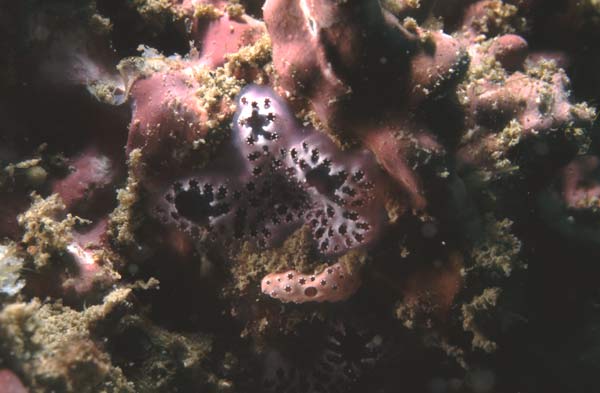
While not as spectacular as some other cnidarians (the above image is certainly beautiful though), zoanthids are common and widespread over the worlds' reefs, often occupying fringe physical environments (intertidal, back reef, other shallow areas, over dead corals). Apart from overgrowing hard coral and rocks, Palythoa has also been observed overgrowing other zoanthids, fire coral, and even anemones. This tolerance to such wide variation of habitat and substrates, particularly in high disturbance zones, highlights their ability to compete aggressively with other coral and reef species for space.
Palythoa caribaeorum is a particularly aggressive, fast growing zoanthid. There is little to no significant predation on the species by other reef dwellers. In small sheltered bays, it forms the dominant substrate with over 75% cover in the shallows (2-5m). It has also been observed overgrowing massive coral colonies in deeper waters. Unlike the stony corals which it overtakes, Palythoa lacks architectural complexity, offering greatly reduced opportunity for use as shelter by other reef life. Palythoa overgrowth of corals is currently being studied in Trinidad, but similar overgrowth areas are now well documented from southern Brazil to Broward County, Florida.
One possibility that has been suggested for the sudden appearance of zoanthid overgrowth is that food supplies that Palythoa prefers are more abundant or increasing--perhaps spurred on by nutrient runoff from coastal agriculture or development. Unfortunately, little is known of the feeding habits of Palythoa. Another idea thrown around is that as reefs shift to greater disturbance regimes due to human-induced stressors (sedimentation, pollluted runoff, increased sea surface temperatures associated with climate change), this new system greatly favors disturbance habitat hardy zoanthid growth over reef-building stony corals. Clearly, more research is needed to help understand and manage this potential reef threat.
The following images show Palythoa caribaeorum overgrowth occurring in several reef areas of the Caribbean. Images courtesy of Coral Cay Conservation. The first image shows zoanthid overgrowth on a brain coral. The second is a zoanthid colony overtaking what appears to be a star coral.


Thursday, March 13, 2008
Very Exquisite Torture
 Speaking in Iowa, Sen. John McCain (R-AZ), who 40 years ago today was shot down, captured, and tortured by the North Vietnamese, took issue with fellow Republican bloviating on waterboarding calling it a clear-cut case of torture.
“Anyone who knows what waterboarding is could not be unsure. It is a horrible torture technique used by Pol Pot and being used on Buddhist monks as we speak,” said McCain after a campaign stop at Dordt College. “People who have worn the uniform and had the experience know that this is a terrible and odious practice and should never be condoned in the U.S. We are a better nation than that.”
McCain said that those who are unsure about waterboarding “should know what it is. It is not a complicated procedure. It is torture.” He has previously called waterboarding “very exquisite torture.”
 This comment comes less than a week after President Bush vetoed legislation meant to ban the CIA from using waterboarding and other harsh interrogation tactics, saying it "would take away one of the most valuable tools on the war on terror." "This is no time for Congress to abandon practices that have a proven track record of keeping America safe," Bush said in his weekly radio address. Valuable tools? Harsh interrogation? Perhaps it's time for W to strap himself down on a board for a little first hand experience?
I'm sorry that this post has nothing to do with oceans. But it has everything to do with humanity. I fully expect to get the usual flames by right wing nutjob trolls who are always vigilant to fan 9/11 fears, or remind this "behavioral deviant from San Francisco" that I'll be dead soon enough. But if we insist on behaving like the "monsters" this administration is allegedly protecting us from, I have to wonder what grandiose values we're supposed to be safeguarding.
Subscribe to:
Posts (Atom)