If you're still lost after reading this, go here, here, or here.
Monday, March 24, 2008


Performing My Civic Doodie
 I've already deferred twice, so today has me catching-up on my reading while sitting in the Alameda County Courthouse on a jury summons. Given the crime rate here in Oakland (and apparently the dearth of registered voters), I sometimes feel like I get called every six months. If I were allowed to bring a computer, you bet your ass I'd be blogging from the courthouse.
Hope your day is more enjoyable.
Sunday, March 23, 2008
It Really Is Better To Give Than To Receive
 Contrary to what you might initially think, giving away your money feels good. A ScienceNow report from last week shows that it's not how much you have that matters, it's how you spend it. People who donate their dollars to charities or splurge on gifts for others are more content than those who horde their riches or spend it on self-indulgent splurges.
Psychologist Kathleen Vohs, with the University of Minnesota in Minneapolis, says she started thinking about the psychology of money when she moved from a postdoctoral position to her first faculty job. The big salary increase meant she could hire a mover instead of relying on help from friends. While it certainly made the move easier, Vohs said that she missed the camaraderie of sharing pizza and beer after a big group effort. The experience led her to hypothesize that while money makes people more independent, it can also act as an isolating social barrier.
To gather evidence for her hypothesis, Vohs collected data on income, spending, and happiness from 632 people across the United States and also recruited several hundred college students to participate in a variety of experiments. In all data sets, happiness correlated with the amount of money people spent on others rather than on themselves or the absolute amount of work-related bonus or income. Vohs speculates that the effects of altruistic spending are probably akin to those of exercise, which can have immediate and long-term effects. Giving once might make a person happy for a day, but "if it becomes a way of living, then it could make a lasting difference," she says.
Not surprisingly, this study is already making ripples outside of behavioral psychology circles. Which is of course music to the ears of those of us who rely on philanthropy for our survival. The Coral Reef Alliance (yes, this is a gratuitous plug) is a member-supported, non-profit organization, dedicated to protecting the health of coral reefs by integrating ecosystem-based management, sustainable tourism, and community partnerships. We're small, efficient, nimble, have tremendously low overhead, and devote the vast majority of our financial resources to direct site-based conservation work. And best of all, our efforts are demonstrating measurable gains in reef health and local community support for conservation.
 So allow me to help make you feel better by offering you a twofer. Click on over to CORAL's donation page and make an investment in conservation that helps us protect a critically threatened ocean ecosystem as well as the local communities that depend on healthy reefs for their survival. Send the link to a friend. Your financial contributions won't just fund important work, it will make you feel good too. It's win-win. So in the words of The Partridge Family: Come On, Get Happy!
Saturday, March 22, 2008
The First, Maybe-Annual, MBSL&S Spring Ocean Egg Hunt
 Since I plan to spend most of the weekend with my legs propped-up while eating milk chocolate bunnies, peanut-butter eggs, and other assorted bon-bons, I thought I'd give my faithful readers a little seasonal fun to keep you occupied. So here's the first, maybe annual Malaria, Bedbugs, Sea Lice and Sunsets Ocean Egg Hunt. The rules are simple: Accurately identify the dozen ocean animal eggs pictured above.
And to all you smarty-pants types who would be quick to squash the fun, Yes, I know, some of these are "egg cases" and not the actual eggs. Yeesh, lighten up! It's a game.
The first person to accurately identify all 12 eggs gets a free copy of our fantastic book: Reef. How cool is that?! Precision counts, so try your best to narrow answers down to a species if possible.
Good luck and try not to OD on too much chocolate.
Thursday, March 20, 2008
Look Before You Leap
 I got an email this morning from Kevin over on The Other 95% to clue me in on a freakish accident that occurred today in Miami when a Spotted Eagle ray leaped from the water onto a boat, striking a 55-year-old woman and killing her. What are the chances? Turns out the ray knocked the woman down, causing her to hit her head which led to her death.
 This isn't the first ray-related collision on record. In 2006 (just a month after Crocodile Hunter Steve Irwin was killed after grabbing a giant stingray while snorkeling along the Great Barrier Reef) a Florida man was similarly stabbed through the heart by a Spotted Eagle ray that leaped onto his boat. However unlike Irwin who pulled out the ray's barb after being stabbed and possibly exacerbating the damage, the Florida man left the barb in place. Doctors were later able to carefully remove the barb in surgery, minimizing further heart damage. The man eventually recovered.
All of this got me to wondering what other leaping aquatic life might have my name written all over it. There have been a number of incidents on Florida's Suwannee River involving sturgeon and various human body parts. One particularly impressive collision between fish and human last year resulted in a broken leg on a six-year-old girl. In 2006, a woman was struck in the face by yet another (or the same disgruntled) sturgeon while boating on the Suwannee. She sustained facial injuries and fractures that required plastic surgery. In 2003 in St. Augustine, Florida, a fisherman was hospitalized after being bitten by a barracuda that jumped into his boat. What's with Florida fish?
A little surfing around YouTube found a few video gems as well. There's the amazing, jumping Asian carp near the Great Lakes:
An absolutely astounding video of a Great White shark high-and-dry atop a boat it landed on in South Africa:
A Tarpon that just can't wait to get to the taxidermist:
And a dubious video of an Orca getting up close and personal with a kayaker:
Not to be outdone by vertebrates, I've heard several anecdotal reports of Humboldt squid leaping onto the decks of sailboats in the Gulf of California, apparently attracted by deck lights on the boats at night. I couldn't find any images or reports anywhere on the net to confirm this. If any readers have info on jumping squid (or other aquatic life that's aiming for us) feel free to leave a comment.
And just to prove it's not just aquatic life that's going all Sopranos on us humans, here's a video of über-hunk Fabio getting whacked (in the face by a goose) while enjoying a rollercoaster ride:
Tuesday, March 18, 2008
Did I Pack My Pastel Jacket?
 I'm off to Miami for one day of meetings with all the coordinating partners of the Mesoamerican Reef Tourism Initiative (MARTI), a joint project of CORAL, Conservation International’s Center for Environmental Leadership in Business, and Cancun-based Amigos de Sian Ka’an. Our combined vision for change along the Mesoamerican Reef is to see tourism become a force for biodiversity conservation and sustainable community development. To do this we are engaging key sectors of the tourism industry — hotels, marine recreation operators, and cruise lines — to significantly reduce the industry’s environmental footprint and maximize its contributions to the protection of the Mesoamerican Reef.
I hate one-day trips like this that have me cross a continent and spew a massive carbon trail only to sit in a room for eight hours and then head straight back. Isn't this why Polycom was invented? Anyway, if anything interesting happens I'll be sure to share.
Monday, March 17, 2008
That's A Moray Monday: The Do-As-I-Say-Not-As-I-Do Edition
 Let's try a blind lead that seems very appropriate for Moray Monday.
What very vocal Hawaii dive operator who has gone on the record as being opposed to voluntary environmental marine recreation standards because (paraphrased),
We already have standards, are operating sustainably already, and have been taking care of the reef for a long time without any more rules!has a very curious and contradictory review from a customer on an online travel advice site,
I'm not the pro diver, but my husband is having logged almost 120 dives. All the recommended dive companies were booked out, so we took what was available. Christmas Eve we set off for Lanai (another of Hawaii's islands). The diver's weren't as expert as those you'd find elsewhere and the equipment wasn't brand new; but we really wanted to dive the Cathedrals - an underwater lava/cavern formation which is lit up by sunlight.While perhaps out of place to include on a moray post, the reviewer also posted this snap of divers harassing an octopus.The first dive was Sergeant Major. (Depth 61 feet/Bottom time 46 minutes). It was a bit of a calamity getting off the boat. There were a few who didn't seem to know how to dive, apparently they were just certified and didn't know how to deflate their BCs. Saw two white tipped reef sharks. The other group saw a moray eel. The photos were taken by the dive shop. This is the eel right before he bit into the hand of the dive instructor who later went to the hospital to get stitches. [Note: Above image illustrates results from a similar moray bite.] I guess he shouldn't have been playing with it.

 If this is taking care of Hawaiian reefs and demonstrating sustainability, I shudder to imagine what carelessness looks like.
Best Search Words, Evah!
 While visiting Harvard last summer at the tail-end of a conference, I blogged about fond memories of some of my favorite Cambridge stomping grounds. Perhaps my ultimate Harvard lore has always been the old chestnut that sex in Widener Library is de rigueur and a right of passage.
 Based on my Site Meter stats from today, apparently the lore is alive, and well, and still living in Harvard Yard. Thank you, ambitious and horny Harvardian, for giving me a chuckle. Hope you got your freak on. If memory serves, the study carrels near the 810 stacks of Literary History & Criticism have some good karma.
Friday, March 14, 2008
Can't We All Just Get Along?
 As if survival wasn't hard enough for coral these days, add another identified threat that's been getting a lot of chatter on the coral science and conservation listserves: inter-species competition.
It seems a particular species of zoanthid (Palythoa caribaeorum) has been observed to be overgrowing living sclerectinian corals throughout the Caribbean. This sort of interspecific competition is nothing new to marine ecologists. Under certain circumstances, various epizoic organism are observed to overgrow living corals--the brown algae Lobophora variegata, the sponge Terpios hoshinota, zoanthids, some ascidians (e.g. Didemnidae), or the octocoral Erythropodium sp. Although epizoism per se does not represent a disease, what is of particular interest and speculation is how human induced nutrient shifts and global warming may induce booming reproduction of faster growing epizoic organisms by upsetting the existing balance and ultimately altering a once flourishing coral reef.
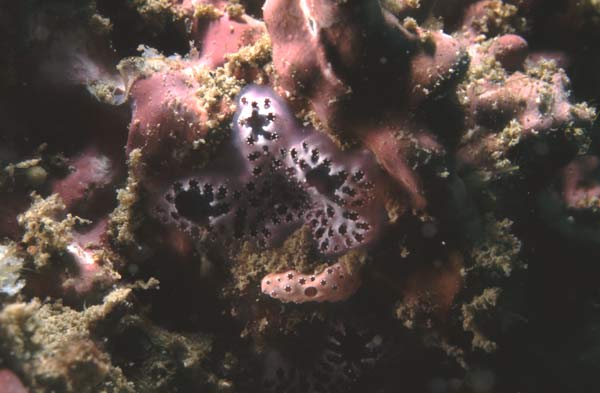
While not as spectacular as some other cnidarians (the above image is certainly beautiful though), zoanthids are common and widespread over the worlds' reefs, often occupying fringe physical environments (intertidal, back reef, other shallow areas, over dead corals). Apart from overgrowing hard coral and rocks, Palythoa has also been observed overgrowing other zoanthids, fire coral, and even anemones. This tolerance to such wide variation of habitat and substrates, particularly in high disturbance zones, highlights their ability to compete aggressively with other coral and reef species for space.
Palythoa caribaeorum is a particularly aggressive, fast growing zoanthid. There is little to no significant predation on the species by other reef dwellers. In small sheltered bays, it forms the dominant substrate with over 75% cover in the shallows (2-5m). It has also been observed overgrowing massive coral colonies in deeper waters. Unlike the stony corals which it overtakes, Palythoa lacks architectural complexity, offering greatly reduced opportunity for use as shelter by other reef life. Palythoa overgrowth of corals is currently being studied in Trinidad, but similar overgrowth areas are now well documented from southern Brazil to Broward County, Florida.
One possibility that has been suggested for the sudden appearance of zoanthid overgrowth is that food supplies that Palythoa prefers are more abundant or increasing--perhaps spurred on by nutrient runoff from coastal agriculture or development. Unfortunately, little is known of the feeding habits of Palythoa. Another idea thrown around is that as reefs shift to greater disturbance regimes due to human-induced stressors (sedimentation, pollluted runoff, increased sea surface temperatures associated with climate change), this new system greatly favors disturbance habitat hardy zoanthid growth over reef-building stony corals. Clearly, more research is needed to help understand and manage this potential reef threat.
The following images show Palythoa caribaeorum overgrowth occurring in several reef areas of the Caribbean. Images courtesy of Coral Cay Conservation. The first image shows zoanthid overgrowth on a brain coral. The second is a zoanthid colony overtaking what appears to be a star coral.


Thursday, March 13, 2008
Very Exquisite Torture
 Speaking in Iowa, Sen. John McCain (R-AZ), who 40 years ago today was shot down, captured, and tortured by the North Vietnamese, took issue with fellow Republican bloviating on waterboarding calling it a clear-cut case of torture.
“Anyone who knows what waterboarding is could not be unsure. It is a horrible torture technique used by Pol Pot and being used on Buddhist monks as we speak,” said McCain after a campaign stop at Dordt College. “People who have worn the uniform and had the experience know that this is a terrible and odious practice and should never be condoned in the U.S. We are a better nation than that.”
McCain said that those who are unsure about waterboarding “should know what it is. It is not a complicated procedure. It is torture.” He has previously called waterboarding “very exquisite torture.”
 This comment comes less than a week after President Bush vetoed legislation meant to ban the CIA from using waterboarding and other harsh interrogation tactics, saying it "would take away one of the most valuable tools on the war on terror." "This is no time for Congress to abandon practices that have a proven track record of keeping America safe," Bush said in his weekly radio address. Valuable tools? Harsh interrogation? Perhaps it's time for W to strap himself down on a board for a little first hand experience?
I'm sorry that this post has nothing to do with oceans. But it has everything to do with humanity. I fully expect to get the usual flames by right wing nutjob trolls who are always vigilant to fan 9/11 fears, or remind this "behavioral deviant from San Francisco" that I'll be dead soon enough. But if we insist on behaving like the "monsters" this administration is allegedly protecting us from, I have to wonder what grandiose values we're supposed to be safeguarding.
Subscribe to:
Posts (Atom)